
SLOTO · PIXMOVE
Falling Pickaxe guide: follow the HP, not just the fall
I break down Pixmove's single-reel instant game, where one random pickaxe falls through a mine, spends durability on every hit and collects only the reward blocks it fully destroys.
My quick verdict
A simple drop is easy to follow, but the durability math gives it real structure.
Falling Pickaxe replaces the usual bank of reels with one short selection wheel and a vertical mining run. The reel decides whether a pickaxe enters the mine; after that, the tool falls, hits blocks and spends durability until its HP reaches zero. That clean sequence makes the game readable within a few demo rounds.
The most appealing part is that every visible object has a job. Ordinary dirt and stone consume durability, ores add small bet multipliers, TNT clears an area, Upgrade Arrows widen the tool and a Workbench repairs and upgrades it. I can see why a run improves without pretending I can control the path.
I would try it for the compact instant-game rhythm and the unusual physical drop. I would skip it when a 95% RTP feels too low, when a 160× ceiling feels too modest, or when Bonus Buy shortcuts would make a deliberately small session difficult to keep small.
The visual style resembles familiar block-building games, but the gambling logic is entirely Pixmove's own instant format. I describe what the reel and mine do without suggesting an affiliation with another game brand.
The quietest useful question is whether I enjoy watching one random path resolve. If that answer is no, extra effects or a higher starting tool will not make the underlying loop a better fit.
The verified profile
Pixmove publishes 95% RTP, low volatility and a 160× maximum.
Falling Pickaxe is an instant game from Pixmove, released on 18 June 2026. The published profile lists 95% RTP, low volatility and a maximum result of 160 times the stake. It is often searched as a slot, but it does not use a conventional five-reel payline or cluster layout.
The 95% figure is a theoretical return over a very large sample of rounds in the stated configuration. It does not mean that one session returns 95% of its stakes, and it cannot tell me whether the next reel selection will show a Cross or a pickaxe.
I still open the information panel in the operator build. Currency, stake limits, available Bonus Buy choices and even mathematical configurations can vary by market, while the exact game screen remains the final reference for the version being played.
Published figures and the opened game answer different questions. The profile gives a common reference point, while the operator screen shows the exact stake and features offered in my region.
Release date is editorial context, not a quality signal. A newer game is not automatically safer, fairer or more generous than an older one.
| Provider | Pixmove | Release | 18 June 2026 |
|---|---|---|---|
| Game type | Single-reel instant game | Reel outcomes | Cross + four pickaxes |
| Published RTP | 95% | Volatility | Low |
| Maximum win | 160× bet | Cross protection | Pickaxe guaranteed on spin 8 after seven Cross results |
| Starting HP | Wooden 100 · Stone 150 · Iron 200 · Diamond 400 | ||
| Ore awards | Copper 0.01× · Redstone 0.05× · Gold 0.20× · Diamond 1× · Emerald 5× | ||
The single reel
Five reel outcomes decide whether a mining run begins and which tool starts it.
Each paid round begins with one reel. Its five possible outcomes are a Cross, Wooden Pickaxe, Stone Pickaxe, Iron Pickaxe or Diamond Pickaxe. A Cross produces no mining drop; one of the four tools opens the vertical field with its corresponding starting durability.
The official rules include a clear protection rule: after seven consecutive Cross results, the eighth spin is guaranteed to award one of the four pickaxes. That guarantee concerns receiving a tool, not its tier, route, ore total or finished payout.
I keep the reel stage separate from the mining stage. The reel selects the starting condition, while the later collisions determine how long the run lasts and which reward blocks are actually destroyed before HP runs out.
The protection rule prevents an unlimited sequence of empty Cross outcomes, but it does not make the seven preceding paid spins free. I include their total cost when evaluating the sequence.
After a pickaxe appears, the Cross counter is no longer a useful guide to the active mine. The remaining questions are durability, collisions and which blocks are destroyed.
Pickaxe durability
Every hit spends one HP, so stronger starting tools can survive more collisions.
A Wooden Pickaxe starts with 100 HP, Stone with 150 HP, Iron with 200 HP and Diamond with 400 HP. The counter is durability rather than a cash balance: each block hit reduces the pickaxe's HP by one, whatever the block eventually pays.
The block also loses one HP per hit. A block is destroyed only when its own counter reaches zero, so touching a valuable ore is not the same as collecting it. The pickaxe may move away or run out of durability before finishing a tougher block.
Higher starting HP creates more room for collisions but does not convert every contact into a reward. I watch the durability counter, destroyed-block animation and settled win separately instead of treating a long descent as a guaranteed large return.
A 400-HP Diamond tool can create a much longer animation than a 100-HP Wooden tool. More screen time is not itself a cash return, so I never compare tiers by duration alone.
Workbench repair can extend the same paid round. That extension does not deduct a new base stake unless the interface explicitly starts another reel selection.
Ordinary blocks and ore values
Harder ores pay more only after the pickaxe fully breaks them.
Dirt and stone have 1 HP and no direct award. They still shape the path and consume one point of pickaxe durability when hit. Their effect is therefore positional: a run can spend much of its life clearing zero-value material before reaching an ore.
Copper has 5 HP and awards 0.01× the bet; Redstone has 10 HP and awards 0.05×; Gold has 15 HP and awards 0.20×; Diamond has 20 HP and awards 1×; Emerald has 30 HP and awards 5×. The values are added only for blocks that are destroyed.
Those numbers explain why a screen full of bright ore can still settle modestly. The path, remaining HP and number of completed destructions matter more than the amount of colour visible around the falling pickaxe.
The ore values are fractions or multiples of the total bet. I use 0.01× and 0.05× exactly as written instead of converting them into fixed currency amounts that would be wrong at another stake.
Several small ores can add together, while one high-value Emerald needs far more damage. The final meter is the reliable summary of every completed destruction.
TNT blocks
Destroyed TNT clears nearby blocks and can change the route quickly.
TNT does not pay simply because the pickaxe passes beside it. The rules state that it explodes when destroyed and removes every block within a defined radius. That can open space, finish nearby ores and alter the remaining fall in one event.
The explosion is useful only in the actual layout it reaches. A TNT block separated from valuable material can create a dramatic animation without a dramatic award, while a better-positioned blast may expose or destroy several relevant blocks.
I wait for the blast sequence to finish before reading the total. Several blocks disappearing together are part of one round calculation, not separate paid spins and not evidence that another TNT is more likely on the next drop.
A blast can also remove ordinary blocks that would otherwise consume later hits. That may improve the route, but the exact benefit depends on the random position and remaining durability.
TNT should not be confused with a bonus trigger. It is a special block inside the current mining run and follows the same one-round settlement.
Upgrade Arrows
Arrow blocks widen the pickaxe for three seconds and can stack to 2.5× size.
Destroying an Upgrade Arrow temporarily increases the pickaxe to 1.5 times its original size for three seconds. Breaking another Arrow while the effect is active raises the size to 2×, and a further active stack can reach 2.5×.
A wider tool can contact a broader corridor of blocks, but width is not a direct win multiplier. It can reach more zero-value blocks as well as more ore, and every actual collision still follows the durability and block-HP rules.
The three-second timer makes the order of events visible. I watch when the arrow is destroyed, whether another one lands inside the active window and how much HP remains before interpreting a wide pickaxe as useful progress.
The larger sprite makes the effect easy to notice on a phone. I still use the live timer and stack state rather than judging the size by eye during a busy collision sequence.
If the wider tool hits several blocks, each block keeps its own HP. The graphic does not automatically destroy everything inside the enlarged outline.
The Workbench
A Workbench fully repairs the tool and upgrades it by one tier.
When the pickaxe destroys a Workbench, its HP is completely restored and the tool moves to the next tier: Wooden to Stone, Stone to Iron, and Iron to Diamond. If the pickaxe is already Diamond, the Workbench simply restores it to full durability.
This is the strongest endurance change in the documented rules because it does two jobs at once for the first three tiers. Even so, the run after the repair remains random and can spend the renewed HP on ordinary dirt and stone.
I treat the Workbench as additional opportunity, not banked value. The final result still comes from reward-bearing blocks actually destroyed before the repaired pickaxe eventually reaches zero HP.
A late Workbench can be more visually dramatic because it restores a nearly empty counter. That timing does not prove the game was about to award it or that another repair is due.
At Diamond tier the repair has no further upgrade to grant. The rules explicitly keep the tool Diamond and refill its durability.
How a round settles
All destroyed reward blocks are added together when the pickaxe reaches zero HP.
The mining sequence continues while the pickaxe has durability. Rewards accumulate across the complete run as Copper, Redstone, Gold, Diamond and Emerald blocks are destroyed. When pickaxe HP reaches zero, the game adds those awards and settles the round.
This order matters when several events overlap. An Upgrade Arrow changes size, TNT can clear a radius and a Workbench resets durability, but none of those effects should be counted as cash on its own unless the live rules attach a separate award.
I compare the final win meter with the original total stake only after the animation ends. A long route, high depth counter or bright explosion can describe the journey without necessarily describing the economic result.
Depth is an interface measure of how far the tool travelled. It can help me follow the run, but the published win is based on collected rewards rather than depth alone.
When the round ends, I pause until the balance and win meter stop changing. That avoids mistaking an intermediate coin animation for the complete payout.
The four starting tools
Tool tier changes the available HP, not the value printed on every ore.
The reel's four pickaxes form a clear durability ladder: 100, 150, 200 and 400 HP. Moving from Wooden to Diamond increases the time a run can remain active, but the ore table itself stays based on the selected stake and the block destroyed.
A Diamond start therefore has more chances to reach deep blocks than a Wooden start, yet it is not a 4× payout multiplier. The physical route can still miss valuable ore or spend many hits on material with no direct award.
That distinction keeps the interface honest: HP tells me how much action remains, while the win meter tells me what has been collected. Mixing the two makes a durable tool look more valuable than the settled rules justify.
Starting tier affects opportunity, not player control. Once the drop begins, I cannot steer the tool toward a preferred ore or avoid a zero-value wall.
The reel wheel may make the choice look arcade-like, but the selected outcome remains random. Timing the spin button does not reveal or influence the next tier.
Bonus Buy choices
Direct-start options change the starting pickaxe and charge a separate displayed price.
The inspected demo includes a Bonus Buy menu for guaranteed starting tools. The displayed price changes with the base bet and with the selected pickaxe tier. Because availability and pricing can vary, I read the full currency amount on the confirmation panel rather than publishing one universal multiplier.
A direct start removes the possibility of a Cross for that purchase; it does not guarantee a particular mine layout, Workbench, TNT chain, depth or finished result. The price is a cost paid before the same random collision rules begin.
For learning the game, I prefer the ordinary demo route first. It shows both the Cross protection rule and the difference between the four natural tools without turning every rules check into a high-cost isolated decision.
I compare a direct-start price with my complete session budget, not only with the small base stake. Several purchases can use the limit much faster than ordinary reel rounds.
If the feature is absent in my region, I do not look for a workaround. Operator and jurisdiction restrictions are part of the available product.
A practical demo checklist
Use demo mode to separate reel selection, HP, block damage and settled rewards.
I begin at the lowest virtual stake, open the rules and note the five reel outcomes. If Cross appears, I count the sequence only to verify the eighth-spin protection; I do not treat the count as a prediction of which pickaxe or mine path will follow.
During a drop I watch four things: starting HP, remaining durability, the health of the block being hit and the reward meter after destruction. That makes it clear why contact with a 30-HP Emerald is not automatically a 5× award.
I also wait for one TNT, Upgrade Arrow or Workbench event and follow the whole animation at normal speed. Demo play can teach timing, controls and readability; a short sample cannot measure the published RTP or forecast paid results.
The demo balance is virtual and cannot be withdrawn. A strong practice run says nothing about the account balance that would result from paid play.
I finish by reopening the rules on a narrow screen. If important counters or confirmation amounts are hard to read, that is a practical reason not to use real money on that device.
Reading the supplied artwork
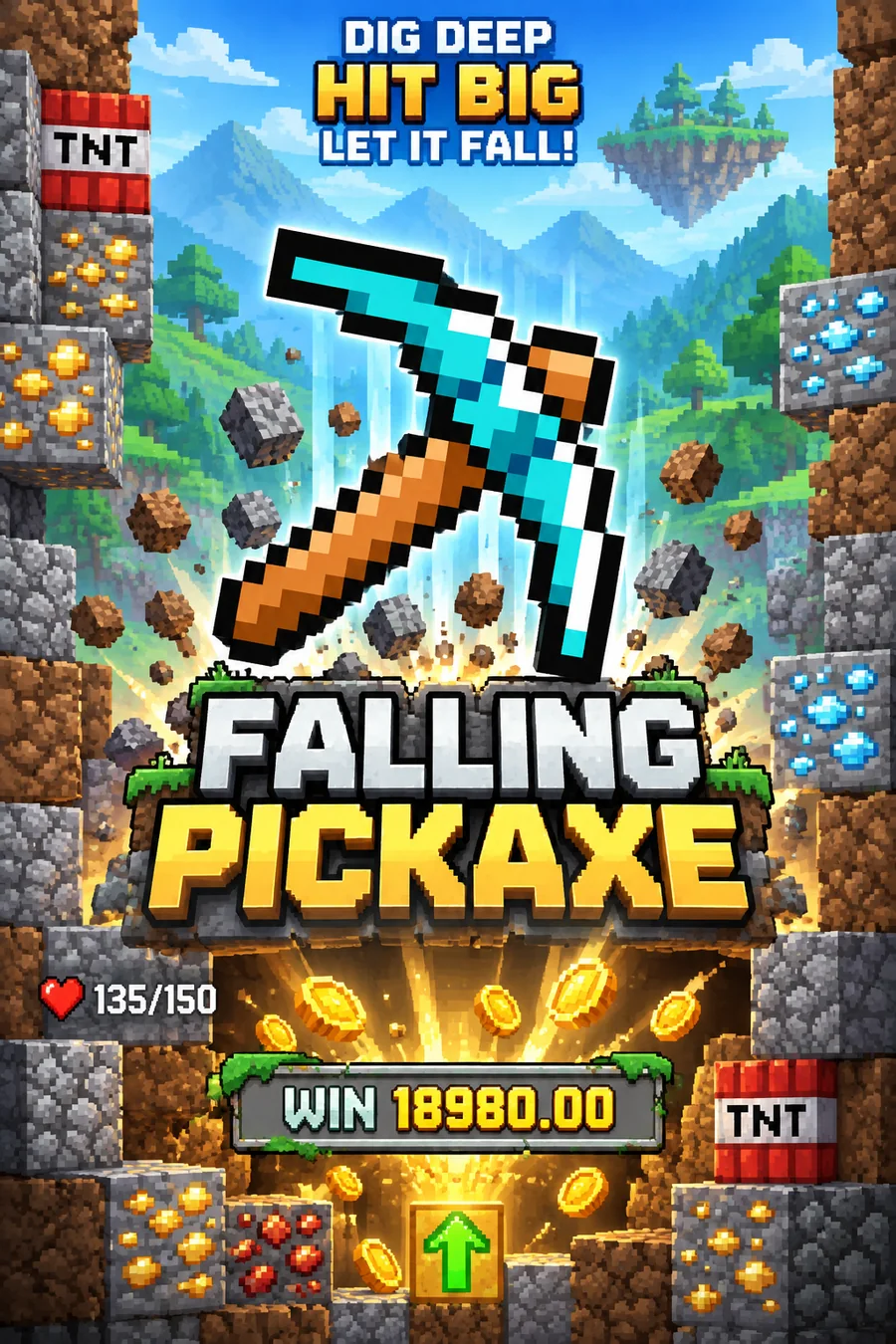
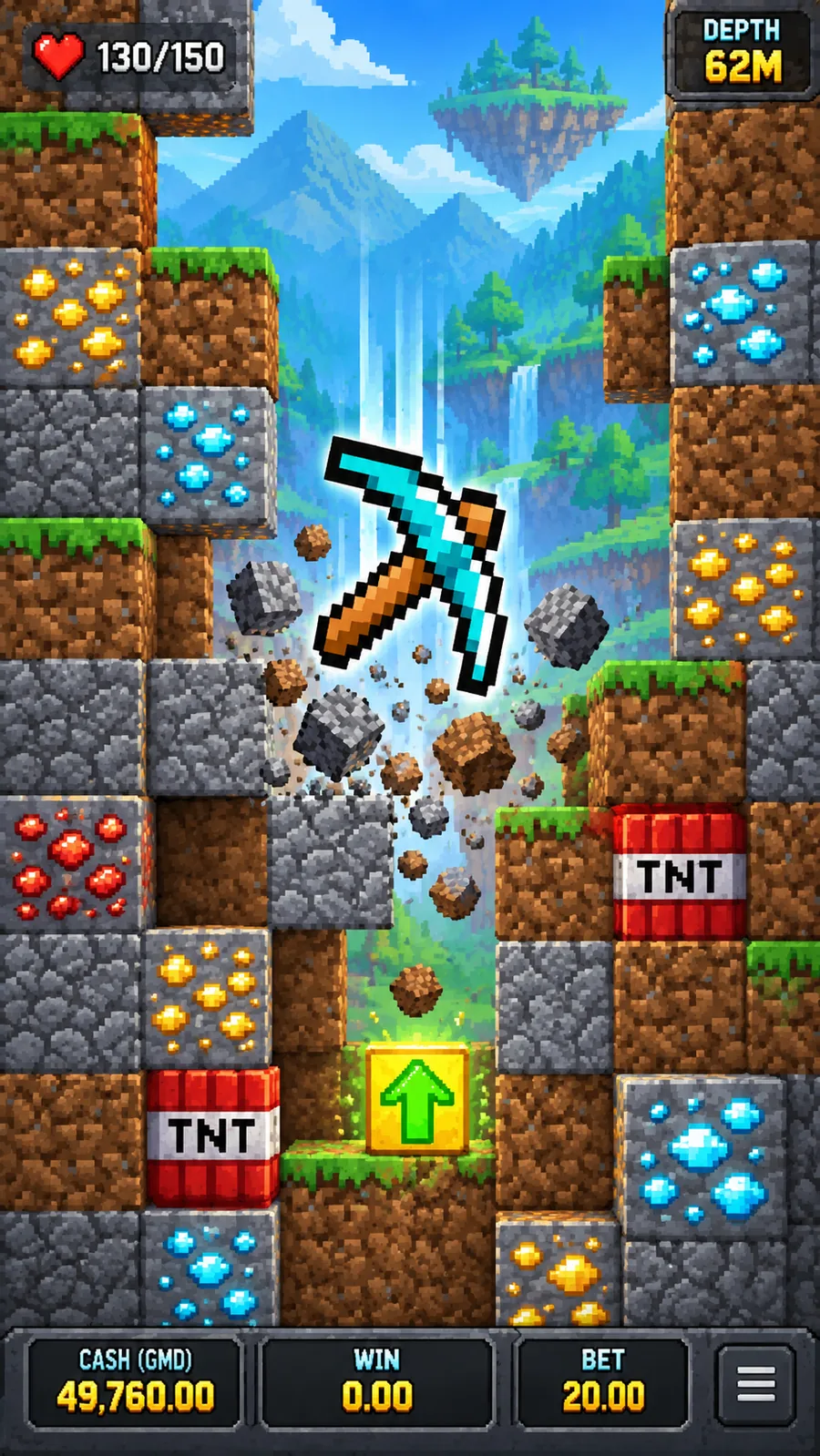
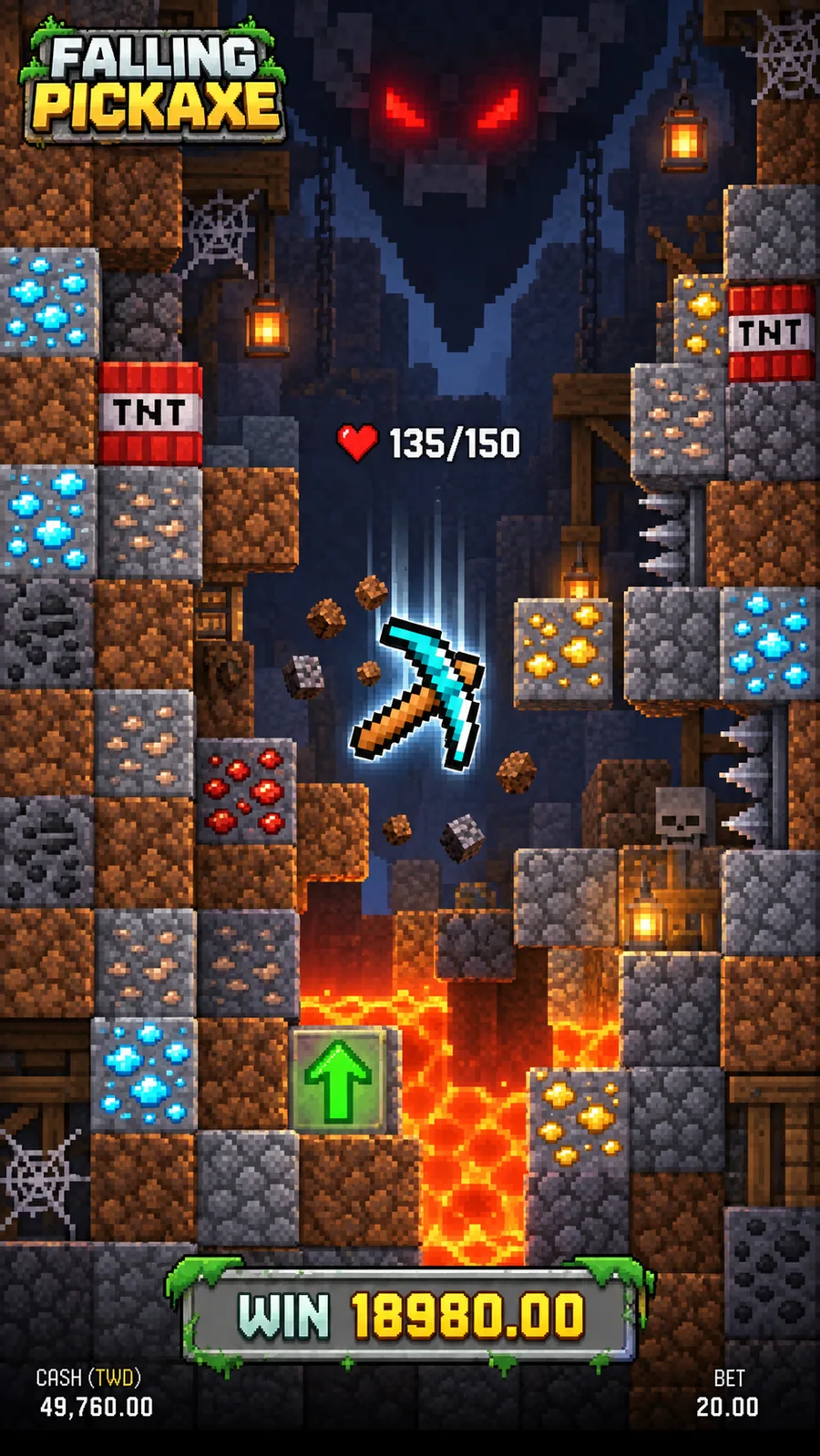
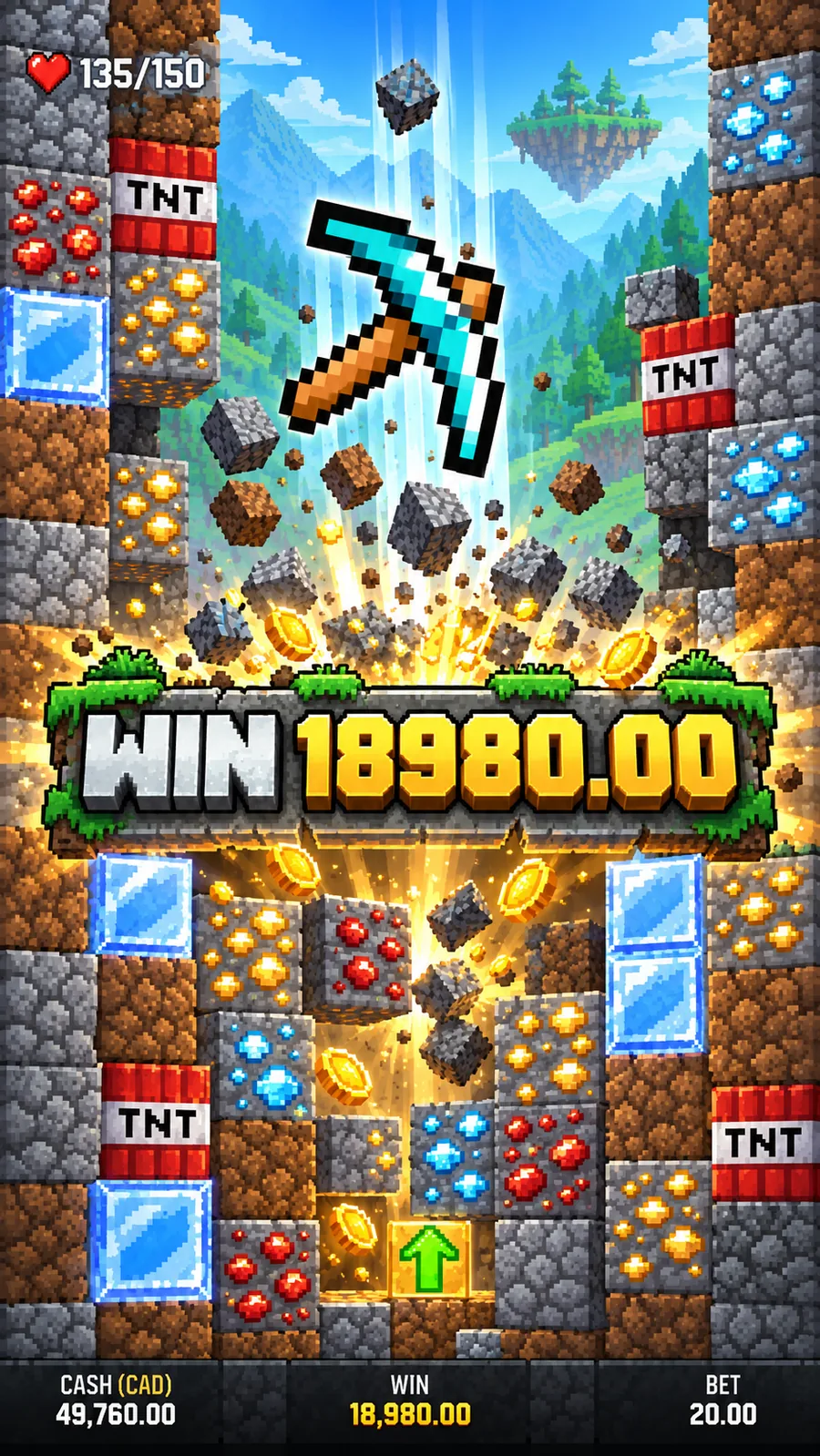
The poster and three vertical scenes are promotional renders, not verified game captures.
The supplied images use the same pixel-mining vocabulary as Falling Pickaxe: large tools, ores, TNT, upgrade arrows and a vertical shaft. They are useful for creating a recognisable page and showing the broad idea of a descending pickaxe.
Their balances, depth counters and large win amounts do not match a verified live session, and some displayed totals would exceed the published 160× ceiling at the illustrated stake. I therefore label every gallery image as an illustrative render rather than an authentic result screenshot.
This separation protects the reader from a misleading comparison. Mechanical claims come from the official rules and published game profile; supplied artwork contributes atmosphere only and never proves frequency, payout size or interface availability.
The page never repeats those renders as evidence in the rules sections. Each transparent decorative cutout appears once, while the three full images stay together in a clearly labelled gallery.
The captions state what is visible and what cannot be inferred. That is more useful than inventing a story about how an impossible promotional total was reached.
RTP, volatility and the 160× cap
Low volatility does not turn a 95% game into a predictable one.
The 95% RTP represents the long-run theoretical return of the stated configuration. It is lower than the roughly 96% headline often seen in modern video slots, so that difference belongs in the decision before play rather than being hidden behind the unusual presentation.
Low volatility describes the distribution relative to other games, generally favouring smaller fluctuations over rare giant prizes. It does not set a schedule for Cross results, guarantee frequent profitable rounds or prevent a session from losing its full planned budget.
The 160× maximum is a hard ceiling for a completed result in the published profile, not an expected target. I never increase the stake to make that ceiling look larger in currency terms; the probability model remains unchanged while the money at risk rises.
A 5% theoretical house edge is the complement of 95% RTP for the stated model. It remains a long-run measure and cannot be converted into a precise loss forecast for a short session.
Low volatility and a modest cap may suit someone who prefers contained outcomes, but they do not make spending harmless. The affordable stake is always the one I can lose without changing plans.
Controls, autoplay and speed
Faster presentation changes waiting time, not the random result.
The inspected interface includes stake controls, spin, turbo, autoplay, sound, rules and Bonus Buy. I confirm the total bet after opening or closing any menu because a compact control panel can make an accidental stake change easy to miss.
Turbo shortens animations but does not improve RTP, tool tier or block placement. I keep normal speed while learning so the Upgrade Arrow timer, TNT radius, Workbench repair and final settlement remain easy to distinguish.
Autoplay can compress many independent paid rounds into a short period. If I use it at all, I choose a finite count and a money limit first, then stop the sequence before changing the stake or opening a direct-start option.
The autoplay infinity option visible in some builds deserves special caution because it removes a natural stopping count. I use a finite setting or leave autoplay off.
Sound and animation can be muted without changing the result. I choose the presentation that keeps counters and spending decisions easiest to notice.
Mobile play and a responsible session
The vertical mine suits a phone, but the limits still need to sit outside the animation.
Falling Pickaxe scales naturally to portrait screens because the action moves downward through a narrow shaft. On mobile I make sure the HP counter, stake, win meter, menu and Bonus Buy confirmation remain readable without rotating or zooming the page.
The repeated Cross animation and a run that ends near valuable ore can create a strong urge to press again. Neither state makes the next outcome due. The eighth-spin protection only applies after seven consecutive Cross results and still guarantees a tool, not a win.
Before opening the game I choose a total spend, one stake and a finish time. I do not buy a stronger pickaxe to recover a weak run, and I stop when the limit arrives. Real-money play is optional adult entertainment and should be used only where legal.
A tall gallery image should remain contained rather than cropped on mobile. The game guide follows the same principle: readability comes before decorative scale.
If play stops feeling like entertainment, I close it. No remaining HP, missed Emerald, Cross streak or purchased tool creates an obligation to continue.
Supplied artwork
Three supplied renders show the mining idea, not verified game results.
These images are promotional illustrations. Their balances, depth counters and oversized win amounts do not document the published 160× game cap or predict another result.
One calm rules check
Learn the durability rules before choosing a stake.
Use demo mode to separate the selection reel, pickaxe HP, block damage, special effects and final settlement, then decide whether a 95% RTP instant game suits the session you planned.
Falling Pickaxe FAQ
Straight answers about RTP, pickaxe HP, ore values and special blocks.
What is Falling Pickaxe?
It is a Pixmove instant game with one selection reel and a falling mining tool. The reel awards a Cross or one of four pickaxes, then the tool breaks blocks until its durability reaches zero.
What RTP and maximum win does Falling Pickaxe have?
The published profile lists 95% RTP, low volatility and a maximum win of 160× the stake. Check the opened operator version for its exact configuration.
What happens after seven Cross results?
If seven consecutive spins land on Cross, the eighth spin is guaranteed to award one of the four pickaxes. It does not guarantee a specific tier or winning mining run.
How much durability do the pickaxes have?
Wooden starts with 100 HP, Stone with 150 HP, Iron with 200 HP and Diamond with 400 HP. Every block hit removes one HP from the tool.
Which ore block pays the most?
Emerald has the largest listed block award at 5× the bet and 30 HP. Diamond pays 1×, Gold 0.20×, Redstone 0.05× and Copper 0.01× after destruction.
What do TNT, Upgrade Arrow and Workbench do?
TNT destroys nearby blocks, Upgrade Arrow widens the pickaxe temporarily and can stack to 2.5× size, while Workbench fully repairs and upgrades the tool by one tier.
Are the supplied gallery images real results?
No. They are illustrative promotional renders. Their balances, depths and win amounts are not verified game captures and must not be used to estimate a typical or possible result.
Core rules were checked in Pixmove's official Falling Pickaxe demo and the mathematical profile was cross-checked against the provider's published game information. The help panel in the opened operator version remains the final reference for its configured RTP, stake range, Bonus Buy prices and regional availability.