
SLOTO · HACKSAW GAMING
Wanted Dead or a Wild guide: read the duel before the gun smoke
I break down Hacksaw Gaming's 5×5 Western slot, where VS symbols can expand into multiplied Wild reels and three bonus games use those Wilds in very different ways.

My quick verdict
A sharp Western slot built for players who accept long quiet stretches between explosive feature rounds.
Wanted Dead or a Wild makes a strong first impression, but I would not mistake its cinematic duels for a gentle game. Hacksaw Gaming rates the volatility at four out of five, and the 15-line structure can feel sparse while the slot waits for a useful Wild, a VS symbol or one of its three bonus games.
The clever part is not the cowboy theme by itself. DuelReels™ can turn a VS symbol into an expanding Wild reel with a multiplier, while the bonus games each change the job of Wild symbols. The Great Train Robbery keeps them sticky, Duel at Dawn increases the chance of multiple VS symbols, and Dead Man's Hand builds a collection before a separate Showdown phase.
I would choose this slot for someone who enjoys learning several connected features and can keep a fixed stake through uneven results. I would avoid it when a session needs frequent feedback or when a dramatic near-miss is likely to encourage another unplanned spin.
The official numbers
The published figures describe the model, not what one session should return.
Hacksaw Gaming lists a five-reel, five-row layout with 15 paylines, volatility of four out of five and a maximum win of 12,500 times the bet. The provider also publishes several RTP configurations: 96.38%, 94.55%, 92.33% and 88.42%. That range makes the information panel in the opened game especially important.
I never assume that the highest advertised RTP is the version offered by a particular operator. The selected configuration can materially change the long-run house edge even though the artwork and features look identical. Before testing the mechanics, I open the rules and record the RTP displayed there.
The 12,500× figure is a ceiling, not a typical target and not a forecast. A screenshot can show a large captured result, but it does not reveal the probability of repeating it. The useful facts are the configured RTP, the payline layout and the exact feature rules in the live build.
| Provider | Hacksaw Gaming | Layout | 5 reels × 5 rows |
|---|---|---|---|
| Win system | 15 fixed paylines | Top listed RTP | 96.38% |
| Other RTP settings | 94.55%, 92.33%, 88.42% | Volatility | 4 / 5 |
| Maximum win | 12,500× bet | Core mechanic | DuelReels™ |
| Bonus games | The Great Train Robbery · Duel at Dawn · Dead Man's Hand | ||
How the 15 paylines work
Wins follow fixed paths, so matching symbols outside a line do not automatically combine.
This is a fixed-payline slot rather than a ways or pay-anywhere game. A regular win needs the required matching symbols on one of the 15 defined lines, normally beginning from the leftmost reel according to the paytable. Symbols that look connected across the grid can still miss if they do not occupy the same active line.
I use the paytable overlay to see the exact route of every line before judging a result. On a five-by-five screen, the small line count leaves plenty of positions that may look relevant but are not part of the same evaluation. The game performs the calculation automatically; the player only needs to understand why the highlighted route qualifies.
Several paylines can win on one spin, and an expanding Wild reel may participate in more than one of them. The total shown by the game combines the valid line wins after the relevant Wild multipliers are applied. It is better to wait for the animation and win meter to settle than to estimate from the symbols alone.
DuelReels™ in the base game
A VS symbol matters only when its expanded reel helps form a paying combination.
Wanted Dead or a Wild introduced Hacksaw Gaming's DuelReels™ mechanic. When a VS symbol lands, two outlaws face each other and the position can expand to cover the reel. The official rule adds an important condition: the expanded reel becomes Wild when it forms part of a winning combination.
The duel produces a multiplier for the victorious outlaw, and that value applies to wins crossing the Wild reel. The presentation makes the confrontation feel like a separate event, but the practical reading order is simple: find the valid payline, identify which expanded reel belongs to it, then read the multiplier attached to that reel.
A VS appearance is therefore potential rather than an automatic large payout. If the expanded result does not complete a paying line, the duel animation has not created money by itself. I keep that distinction clear because the sound and framing can make every VS symbol feel more valuable than its final evaluation.
Combining Wild-reel multipliers
Multipliers on the same winning line are added together before that line is boosted.
The official description states that when more than one Wild reel shares the same winning combination, their multiplier values are totalled and the payline win is multiplied by that sum. This is additive combination, not multiplication of one reel value by another.
For a simple reading example, a qualifying line that crosses a 2× Wild reel and a 3× Wild reel uses a combined 5× modifier for that line. The example explains the arithmetic only; it is not a simulated spin and says nothing about how often those reels will appear together.
Different winning lines may pass through different sets of Wild reels, so their modifiers can differ inside one result. I let the game resolve every highlighted line before comparing the final total with the base symbol values shown in the paytable.
The Great Train Robbery
Sticky Wilds turn the feature into a screen-building bonus rather than a duel hunt.
In The Great Train Robbery, every Wild symbol that lands remains in place and can contribute to winning combinations again on later feature spins. The objective is easy to understand: more sticky positions create more opportunities for the 15 paylines to pass through Wilds.
Sticky does not mean that a Wild pays on its own. A valid line still needs the required matching symbols, and a screen with several Wilds can produce a modest result if the surrounding symbols do not connect. Persistence changes the available positions; it does not remove random outcomes.
When I test this feature, I watch the Wild map rather than only the running total. That shows how early and late Wilds affect the remaining spins. A strong final screen is one possible outcome, while a bonus with few useful additions remains entirely possible.
Duel at Dawn
This mode concentrates on VS symbols and can expand several DuelReels™ in one spin.
Duel at Dawn increases the chance of landing multiple VS symbols. Hacksaw Gaming notes that as many as five DuelReels™ can expand, placing the core duel mechanic at the centre of the bonus rather than leaving it as an occasional base-game event.
The same evaluation discipline still applies. I check which expanded reels actually join a payline and then combine the multipliers that share that line. A screen full of duels is visually dramatic, but only the completed winning routes determine the payout.
The provider describes this feature as the game's strongest route toward the maximum win. I read that as a statement about potential, not a reason to expect a particular bonus to be large. A feature can contain several confrontations and still finish well below the advertised ceiling.
Dead Man's Hand
The first phase gathers resources; the Showdown phase is where the collection is used.
Dead Man's Hand has two distinct stages. During the collection phase, the game gathers Wild symbols and multipliers. Those values prepare the feature but should not be read as a settled payout while the collection is still being built.
During Showdown, the collected Wilds are placed on random positions for every spin and the accumulated multiplier applies to wins. This separation is the key to understanding the mode: phase one defines the tools, while phase two repeatedly deals them onto new layouts.
I note the number of collected Wilds and the accumulated multiplier before Showdown begins, then watch how random placement changes their usefulness from spin to spin. A large collection can still land awkwardly, and a smaller collection can sometimes connect with a valuable line.
Bonus Buy and regional availability
Direct feature access changes the price and pace, not the random rules inside the bonus.
Hacksaw Gaming lists Bonus Buy as a feature that can open one of the bonus games without waiting for a natural trigger. The option, available modes, price and RTP treatment can differ by market or operator, and some jurisdictions do not permit feature purchasing at all.
I check the confirmation panel before using any direct-access option because its cost is expressed relative to the base stake. A high multiple of a small-looking bet is still a large single decision. Buying a feature does not guarantee that its return will meet or exceed that cost.
Demo mode is the sensible place to compare the three bonuses. It reveals how their rhythms differ without turning the comparison into three expensive purchases. If the control is absent, I treat that as a property of the available version rather than a fault in the page or device.
A practical demo checklist
One careful demo pass should answer rule questions, not predict a future session.
I begin at the lowest virtual stake, open the paytable and trace all 15 lines. Then I watch an ordinary spin from start to finish, paying attention to the left-to-right evaluation and the difference between a standard Wild and a VS-triggered expanding reel.
When a duel appears, I record the reel multiplier and check whether the Wild reel actually joins the highlighted line. If two multiplied reels share a win, I confirm that their values are added. This single observation prevents the common mistake of multiplying the multipliers together.
If a bonus starts, I identify the mode before reading the result: sticky Wild accumulation for Train Robbery, frequent DuelReels™ for Duel at Dawn, or collection followed by Showdown for Dead Man's Hand. A lucky demo sample explains presentation, never probability.
Reading the supplied screens
The gallery documents interface states and captured outcomes, not expected returns.
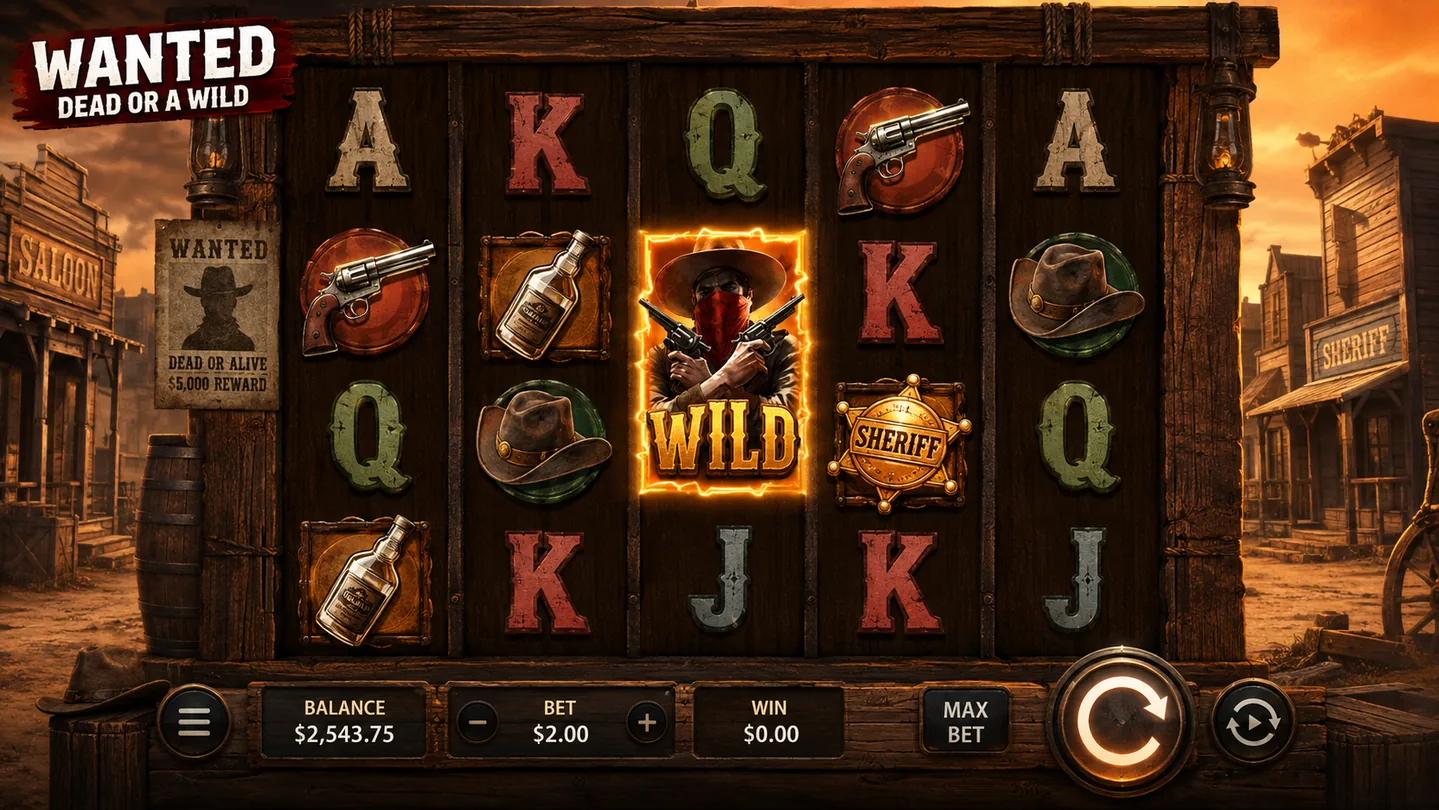
The first supplied screen shows the five-by-five base layout, ordinary Western symbols and a highlighted Wild position. I use it to locate the balance, bet, win display and spin controls, while remembering that the displayed currency is illustrative.
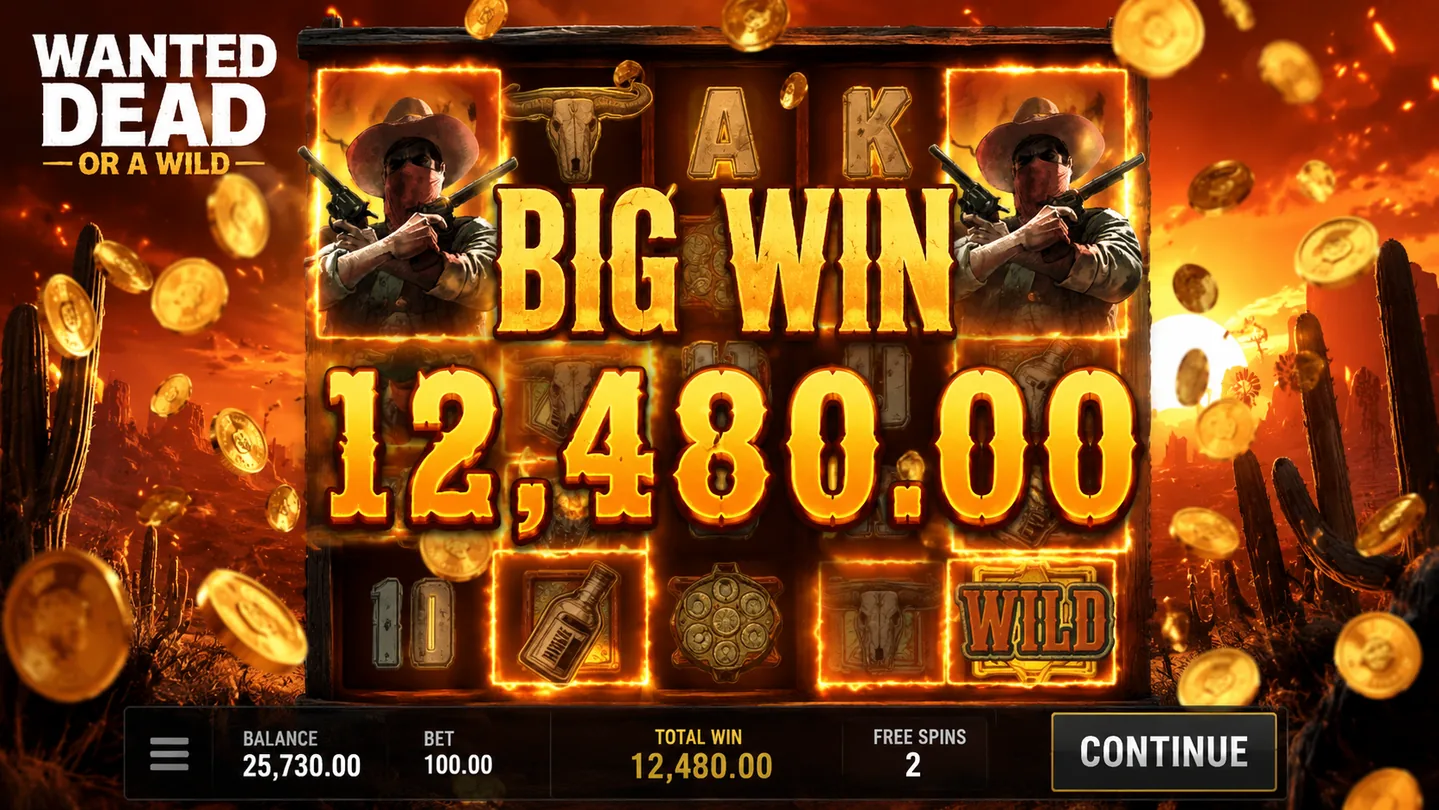
The second image captures a large celebration with two expanded outlaw reels. It is useful for recognising a DuelReels™ result and seeing how prominently the game presents a completed total, but the number belongs only to that captured round.
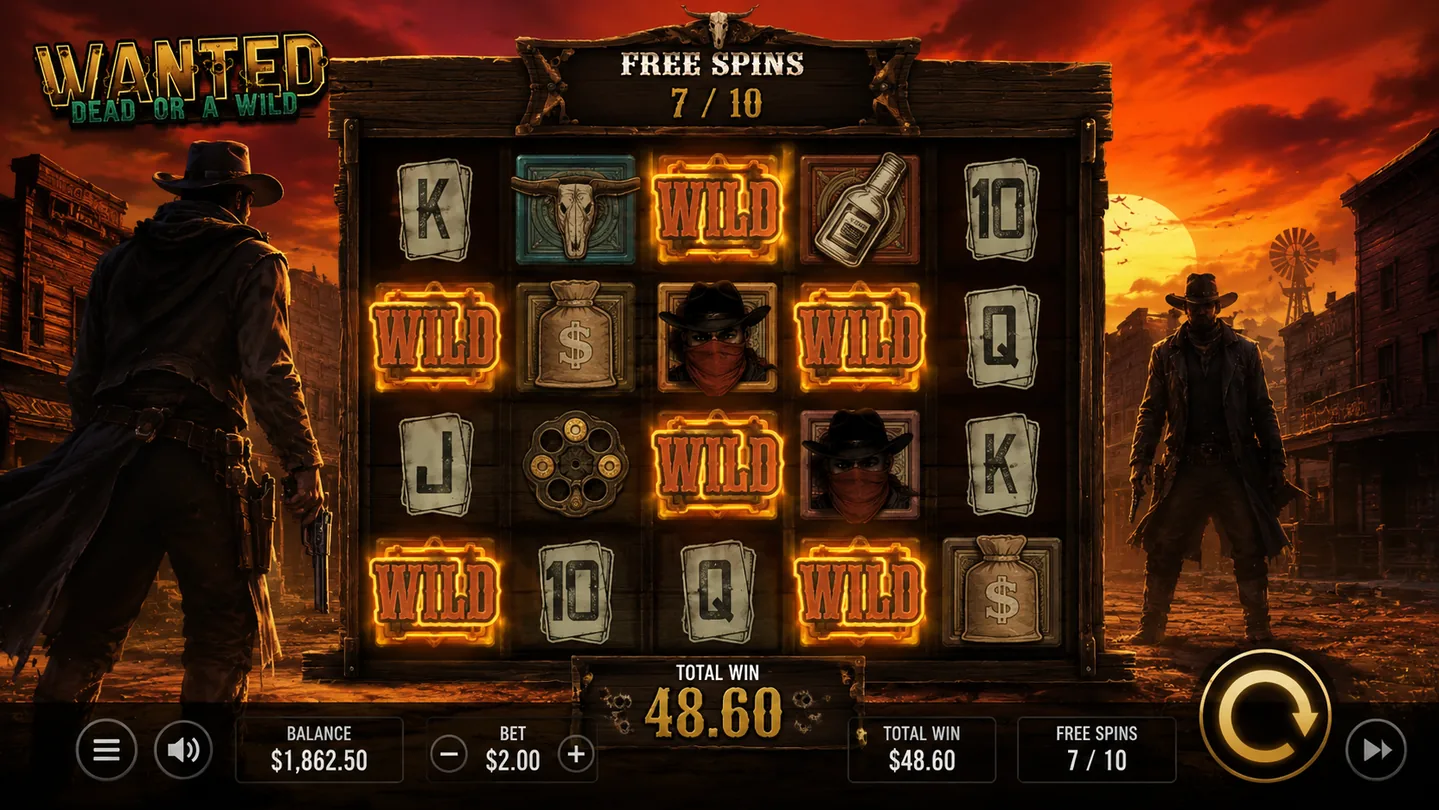
The third screen shows a Free Spins state with several sticky Wild positions and a remaining-spin counter. It demonstrates how the grid can develop during a feature. It does not promise that another bonus will collect the same number or placement of Wilds.
RTP and volatility in practice
A high published RTP cannot smooth a high-volatility session.
RTP is calculated across a very large number of rounds for one configured version. At 96.38%, the theoretical house edge is still present, and short sessions can finish far above or below the model. Lower listed configurations widen that long-run difference.
Volatility of four out of five describes uneven result distribution. The game can spend many spins on small or empty line evaluations before a useful duel or bonus changes the pace. That profile is entertainment preference, not evidence that a feature becomes due after a quiet run.
My stake must remain comfortable through the ordinary stretches, not only during a spectacular feature. If I need to increase the bet to make base-game results feel meaningful, I have chosen the wrong stake or the wrong volatility profile for that session.
Mobile controls and readability
The game fits a phone well when the paytable, stake and feature counters remain easy to verify.
Hacksaw Gaming designs for mobile play, but a five-by-five grid and several feature counters still need enough screen space. I test portrait and landscape orientation, confirm that the balance and total bet remain visible, and open the rules without accidental taps on the spin control.
Fast play shortens presentation; it does not change the result already generated. For the first demo session I keep normal speed so DuelReels™, multiplier labels and sticky Wild positions are readable. Once the sequence is understood, speed becomes a comfort setting rather than a strategy.
On a smaller screen I wait until every duel and win count has finished before pressing again. This keeps the result legible and reduces accidental repeat inputs. The same spending and time limits apply whether the controls sit under a desktop grid or beneath a phone screen.
Common reading mistakes
The slot becomes clearer when presentation, potential and settled wins are kept separate.
The first mistake is treating every VS symbol as a guaranteed payout. It must expand into a Wild reel that participates in a winning combination. The second is multiplying two Wild-reel multipliers together, even though the official rule says to add values that share one winning line.
Another mistake is comparing all three bonuses as if they use the same logic. Train Robbery preserves landed Wilds, Duel at Dawn focuses on multiple DuelReels™, and Dead Man's Hand separates collection from Showdown. Each needs a different screen-reading habit.
Finally, a large captured win or a full-looking grid does not make the next spin more promising. Every new paid round is random. The most useful information remains the active paylines, the displayed configuration and the feature state currently on screen.
Game screens
Three supplied screens show the base game, a duel result and sticky Wilds.
These images document captured interface states. Their balances, bets, symbols and totals do not predict another round.
My limit before high noon
I decide my limit before the first showdown.
I choose the stake, maximum spend and finish time before the first spin. A VS symbol or an almost-full Wild screen can feel unfinished, but neither creates a debt for the next random round.
If I increase the stake to recover a quiet stretch or buy another feature because the last one felt close, I have left the plan. That is my signal to stop.
One calm rules check
Learn one duel in demo, then decide whether the volatility fits.
The useful question is not whether a 12,500× result exists, but whether 15 paylines, uneven pacing and the three different feature structures suit the session you planned.
Wanted Dead or a Wild FAQ
Straight answers about RTP, DuelReels™, Wild multipliers and the three bonuses.
What RTP does Wanted Dead or a Wild use?
Hacksaw Gaming publishes four configurations: 96.38%, 94.55%, 92.33% and 88.42%. Check the information panel in the version you open because the operator selects the available configuration.
What are DuelReels™?
A VS symbol can expand into a Wild reel when the expanded reel forms part of a winning combination. The winning outlaw supplies a multiplier to qualifying paylines crossing that reel.
How do multiple DuelReels™ multipliers combine?
When several multiplied Wild reels share the same winning line, their values are added and that sum multiplies the payline win. They are not multiplied by one another.
What happens in The Great Train Robbery?
Wild symbols that land become sticky and stay available for later feature spins, where they can participate in valid 15-payline combinations again.
How is Dead Man's Hand different?
It has a collection phase for Wilds and multipliers, followed by Showdown. During Showdown the collected Wilds are placed randomly on each spin and the accumulated multiplier applies to wins.
What is the maximum win?
Hacksaw Gaming advertises a maximum of 12,500 times the bet. This is a ceiling, not a typical result or a guaranteed target for a bonus.
Core rules and mathematical figures were checked against the official Hacksaw Gaming page for Wanted Dead or a Wild. The help panel in the opened game remains the final reference for its configured RTP, bet range, feature prices and regional availability.