
Pragmatic Play cluster-pays slot
Sugar Rush guide: where candy clusters build serious multipliers
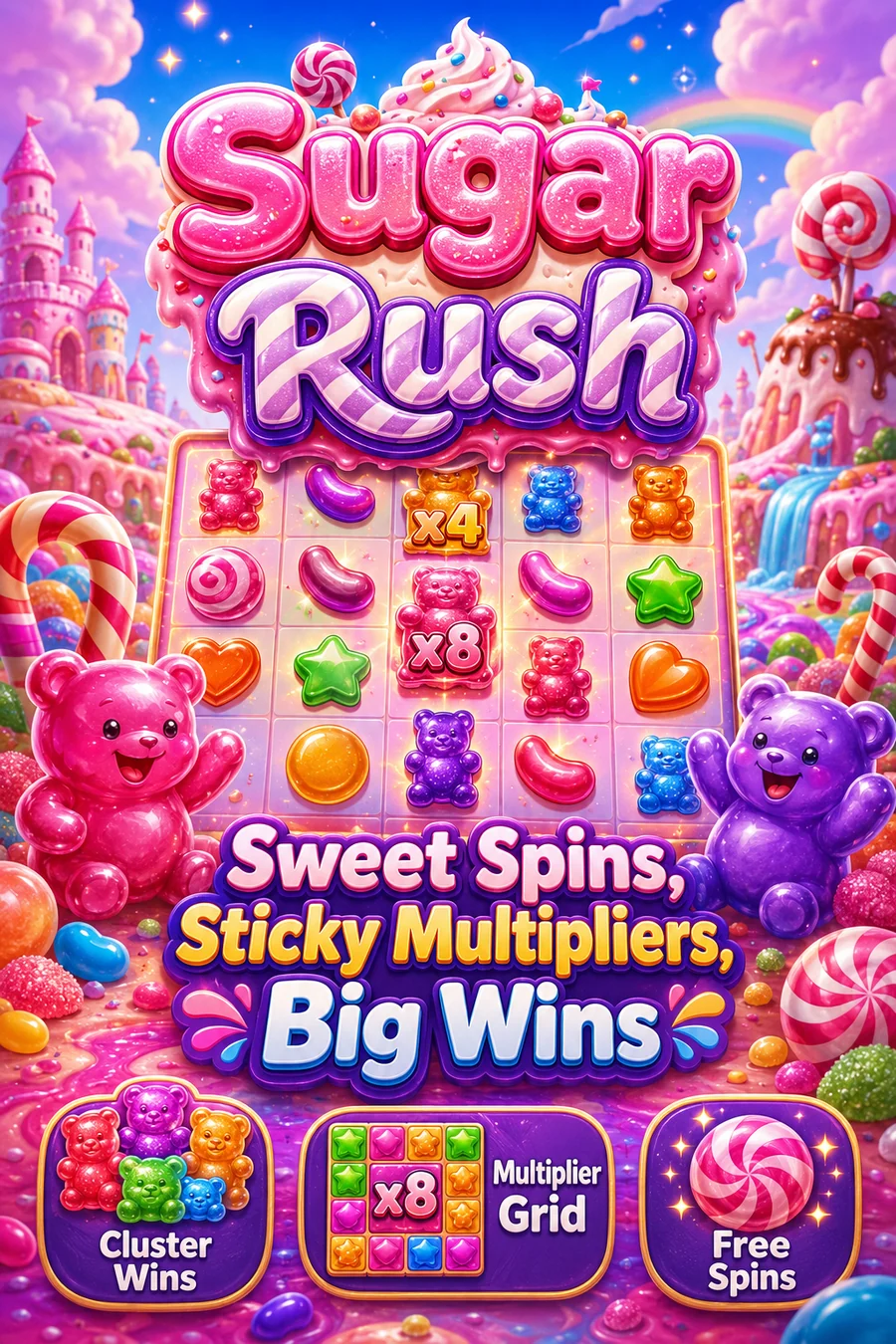
Sugar Rush looks like the friendliest sweet shop in the casino, but I read it as a patient grid-building slot. The base game teaches me to see clusters and tumbles. The free spins then turn the positions used by those wins into persistent multiplier spots, so one useful corner of the 7x7 board can become the centre of the whole feature.
My verdict
A clever cluster slot hidden inside a candy jar.
I enjoy Sugar Rush because it gives the grid a memory during free spins. Many tumble slots reward a chain reaction and then wipe the emotional slate clean. Sugar Rush lets winning positions remain important. Once a cluster marks several cells with multipliers, I start watching the shape of the board rather than only the size of the next group of symbols.
That small design choice creates the game's best tension. A multiplier spot can climb from 2x to 4x, 8x and beyond when later wins reuse it. Multiple active spots inside the same winning cluster are multiplied together, which is why a compact group in the right area can suddenly matter far more than a visually larger cluster somewhere else. The feature feels like it is building a route, even though every symbol drop remains random.
The important word is random. A beautiful patch of high multipliers does not force matching symbols to land there again. The game knows exactly how tempting an unfinished multiplier area looks. I enjoy that tension, but I never treat it as a debt the next spin must repay.
Verified Sugar Rush facts
The numbers I check before the first cluster.
I use the official Pragmatic Play Sugar Rush page for the game's identity and published headline values, then verify the information panel inside the version I open. Casinos can offer different configurations, bet ranges and optional feature settings. The live rules always outrank a review page.
| Game | Sugar Rush, the original 2022 release |
|---|---|
| Provider | Pragmatic Play |
| Grid | 7 columns by 7 rows |
| Win system | Clusters of 5 or more matching symbols connected horizontally or vertically |
| Main mechanic | Winning symbols tumble away and new symbols fall into their positions |
| Free spins | 3, 4 or 5 scatters award 10, 12 or 15 spins; retriggers can raise the total to 30 |
| Multiplier path | 2x, 4x, 8x, 16x, 32x, 64x and 128x on reused winning positions during free spins |
| Standard RTP | 96.50%; verify the exact opened version |
| Volatility | High |
| Maximum win | 5,000x stake in the standard original game |
How Sugar Rush pays
Forget paylines. Look for connected neighbourhoods.
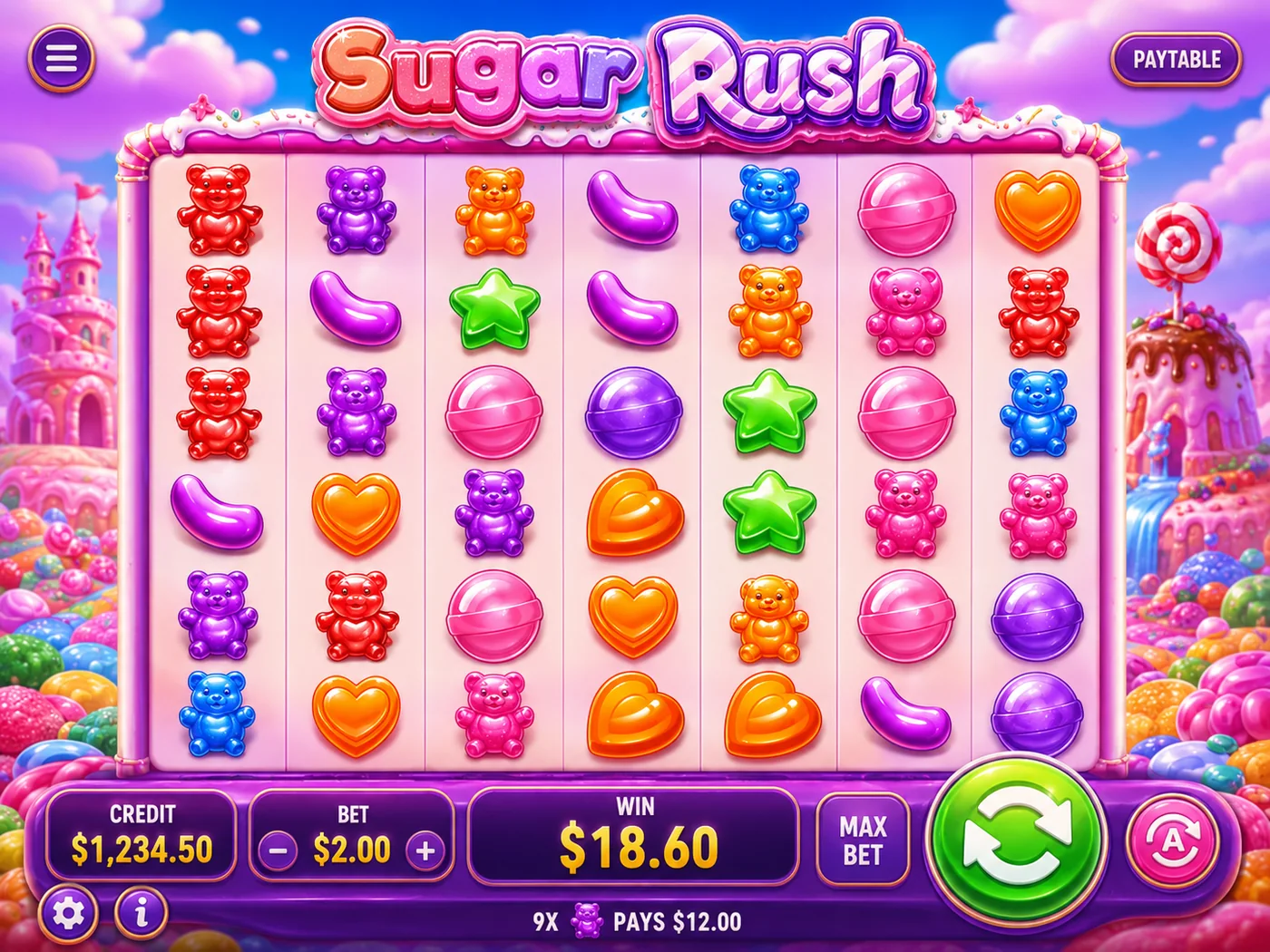
A Sugar Rush win starts when at least five identical symbols touch along their sides. Diagonal neighbours do not complete the cluster. This rule makes the board feel less like seven reels and more like a tiled map. I scan for groups that share an edge, then count whether the group is large enough to pay.
Cluster size matters because larger groups pay more according to the game's paytable. The exact values differ by symbol, but the reading habit stays simple: first identify the symbol, then trace every connected side, then check the final cluster size. Several separate clusters can pay in the same result.
After a paying cluster is counted, its symbols disappear. New candy falls into the empty positions, and the board checks again. That tumble sequence continues until no new winning cluster forms. One paid spin can therefore produce a short chain of results, but a long chain does not make the next paid spin more favourable.
Edges connect. Corners do not. Five matching neighbours begin a payout, and every payout earns a fresh tumble.
A tumble is a new chance inside the same paid spin.
I let every cascade finish before touching the controls again. The clean pause helps me understand which cluster paid, where new symbols landed and whether the round is truly over. Fast play can make three clear events feel like one confusing flash.

Sticky multiplier positions
The bonus remembers where a winning cluster touched the grid.
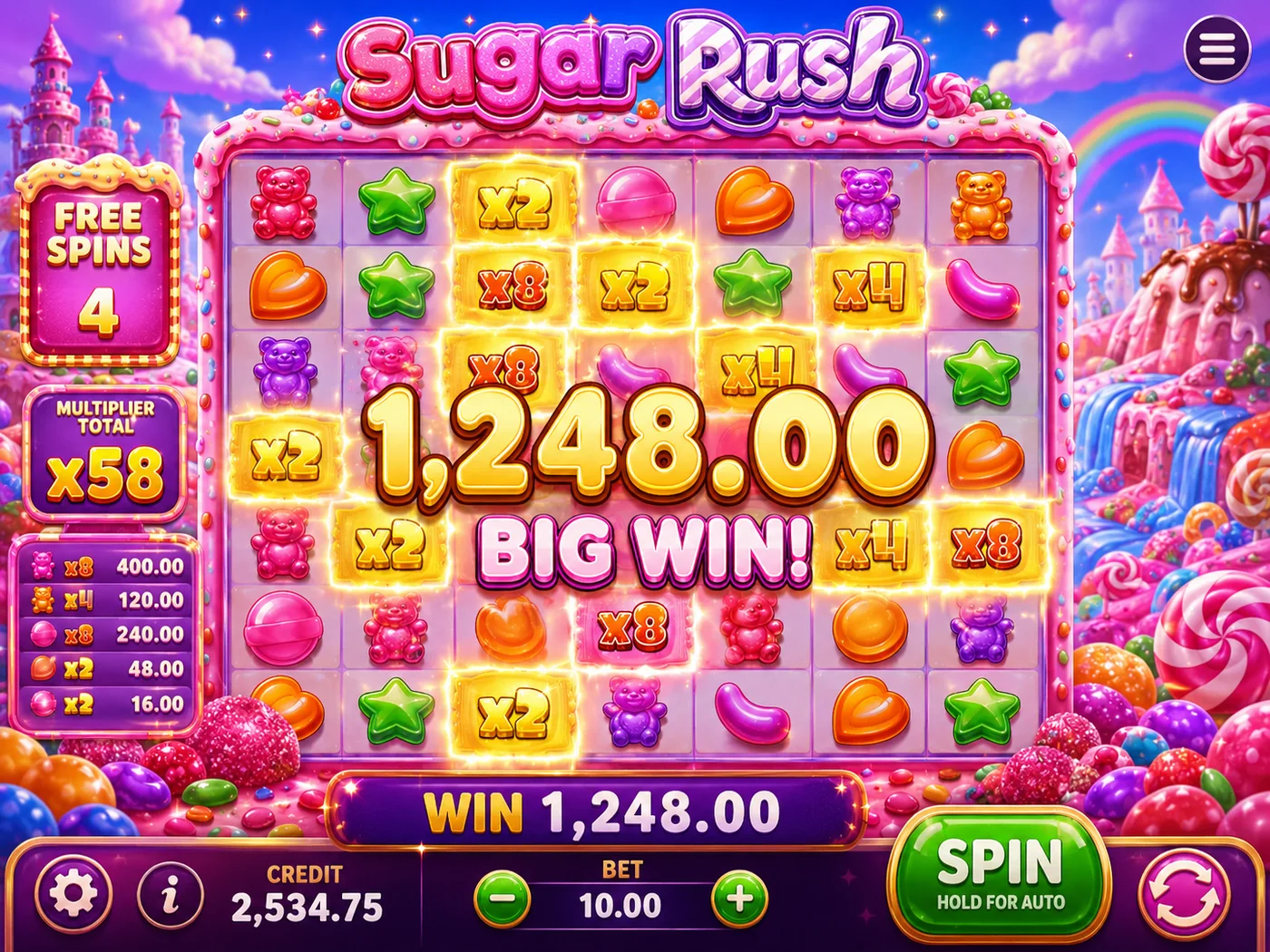
During free spins, every position occupied by a winning cluster receives a 2x multiplier spot. If a later winning cluster uses that position again, the multiplier doubles to 4x, then 8x, 16x, 32x, 64x and finally 128x. The spots remain on the board for the rest of the feature, which turns the grid into a visible record of useful hits.
The strongest detail is how several active positions combine. When one paying cluster covers more than one multiplier spot, those spot values are multiplied together before being applied to the cluster win. A 4x and an 8x used by the same cluster create a 32x multiplier. That is why the best-looking board is not always the one with the most coloured cells; concentration can be more powerful than coverage.
I still avoid the easy mental trap. A 128x spot at the centre of the grid is exciting, but it has no value until a future paying cluster actually uses it. The spot changes the value of a qualifying win. It does not pull matching symbols toward itself.
Build one sticky multiplier by hand.
Tap any candy cell repeatedly. Each tap represents a later winning cluster reusing that same position during free spins.
Sugar Rush free spins
Ten spins can become a story about one corner of the board.
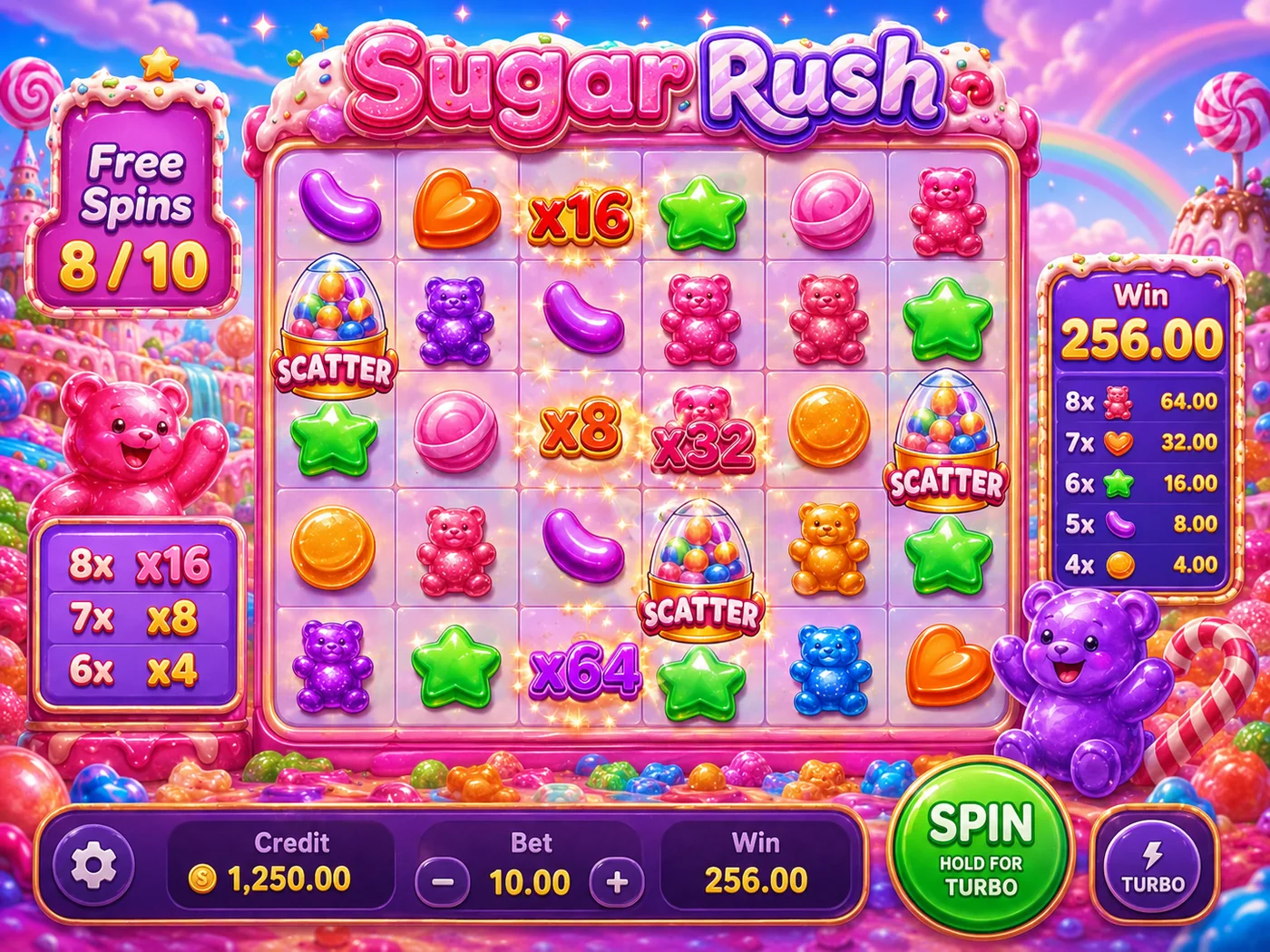
Three scatter symbols trigger 10 free spins, four award 12 and five award 15. Further scatters during the feature add more spins, with the standard game allowing the total to reach 30. Retriggers matter because every extra spin gives the existing multiplier map more time to become useful.
The opening spins often decide where my attention goes. A broad early cluster can mark several cells. A later cluster that reuses only part of that patch can raise a few positions. If those cells are hit again, the feature begins to feel focused. The visual story is easy to follow because the multipliers remain visible between spins.
I judge the bonus by the final payout, not by how promising the map looked halfway through. A board covered with multiplier spots can still end quietly if matching symbols avoid them. A modest-looking map can produce a strong result if one cluster crosses several upgraded positions. Sugar Rush makes possibility visible without making it certain.
Early multiplier coverage, repeated hits on the same cells, clusters crossing several spots, remaining free spins and the actual accumulated win.
2x looks small until the same position keeps working.
The ladder doubles at each useful revisit: 2x, 4x, 8x, 16x, 32x, 64x and 128x. I enjoy watching it grow, but I remember that the highest visible value still needs a paying cluster to cross it.

My Sugar Rush demo route
I use free play to learn the board, not to search for a winning pattern.
The demo is useful because Sugar Rush has two reading modes. The base game teaches cluster shapes and tumble speed. The free-spins round teaches how persistent multiplier positions change the value of later clusters. I keep the virtual stake fixed so I can focus on mechanics rather than constantly changing the numbers.
- First ten spins: I count connected symbols and check that I understand why every paying cluster qualifies.
- Next ten spins: I follow each full tumble sequence and wait for the board to settle before starting again.
- First bonus: I watch where the earliest multiplier spots appear and whether later wins reuse them.
- Second bonus: I compare broad coverage with concentrated upgraded positions and judge only the final total.
- Mobile test: I check whether small multiplier values, remaining spins, stake and balance remain easy to read.
A demo run cannot prove the future RTP, predict bonus timing or reveal a secret stake. Random results can create very different short samples. The useful question is simpler: do I enjoy the ordinary grid enough to remain comfortable while waiting for the feature?
RTP, volatility and maximum win
The soft colours sit on top of a high-volatility game.
The standard original Sugar Rush is commonly published with a 96.50% RTP, high volatility and a maximum win of 5,000x the stake. RTP describes a theoretical return across a very large number of rounds. It cannot tell me whether tonight's short session will be strong, weak or somewhere in between.
High volatility fits the design. Many base-game spins can feel ordinary, while the free-spins round can become far more important if clusters repeatedly revisit upgraded multiplier positions. That uneven distribution is the point, not a defect. It is also why I choose a smaller stake than the candy artwork might emotionally suggest.
I always open the information panel before real-money play. Pragmatic Play games can appear with different RTP configurations or feature options in different casinos and regions. I verify the displayed RTP, minimum and maximum bet, bonus-buy price where available and maximum win rule. A familiar logo does not guarantee an identical configuration.
A good session plan should still make sense if no spectacular feature arrives. If the stake only feels comfortable when I imagine the maximum win, the stake is already too large.
Sugar Rush screenshots
Three screens that explain the entire slot.
I like screenshots when they teach mechanics rather than merely decorate a page. The base-game screen shows how clean the 7x7 cluster board is. The two free-spin screens show why persistent positions change the conversation: once multipliers appear, location becomes as important as symbol count.
Sugar Rush comparison
Choose the mechanic you want, not only the sweetest poster.
Sugar Rush shares the bright tumble-slot family with several famous games, but its persistent position map gives it a distinct personality. I compare slots to choose a rhythm, never to claim that one random game is easier to beat.
| Slot | Main win system | Bonus hook | My reading of the mood |
|---|---|---|---|
| Sugar Rush | 7x7 cluster pays and tumbles | Winning positions build persistent multipliers up to 128x | Patient board building with a sweet skin |
| Sweet Bonanza | Pay-anywhere wins and tumbles | Multiplier bombs join paying tumbles during free spins | Fast, colourful and more immediately chaotic |
| Gates of Olympus | Pay-anywhere gem wins and tumbles | Zeus drops multipliers that combine with a paying tumble | Dramatic and direct, without a persistent position map |
| Sugar Rush 1000 | Familiar cluster and tumble foundation | A later amplified version with different multiplier values and headline potential | More extreme; the original is cleaner for learning the core idea |
Sugar Rush on mobile
The grid fits a phone, but multiplier details still deserve attention.
The square 7x7 board and large candy symbols translate well to modern Android and iPhone browsers. I can usually understand clusters without zooming, and the tumble animation remains clear in portrait or landscape mode. The free-spins map is the real test because several multiplier values may be active at once.
Before opening a paid session, I use the demo on the exact device and connection I plan to use. I check that the stake, balance, total win, scatter count, remaining free spins and small multiplier values are readable. If a browser hides controls or the connection skips animation, I change the setup rather than guessing what happened.
Mobile speed can also make a high-volatility slot feel deceptively casual. Sugar Rush can move from one tumble to the next quickly, and a phone is always within reach. I use a real timer and keep autoplay limits conservative. Convenience should reduce friction, not remove decisions.
Session planning
I set the stop before the multiplier map starts negotiating.
Sugar Rush is especially good at creating unfinished visual business. A promising group almost connects. Two scatters appear. A free-spins board ends with several upgraded positions that looked ready for one more hit. None of those moments changes the independence of the next paid spin.
This simple planner divides a chosen budget by a chosen base-game stake. It is not a forecast of how many spins the balance will actually survive because wins, bonus buys and optional feature costs change the path. I use the number as a calm reference point, then stop at the budget or time limit even when the board looked promising.
If a bonus buy is available in my region, I treat its cost as a separate decision. Buying access to the volatile feature changes the price of the round; it does not improve the random value of that particular result. I never hide a feature purchase inside an ordinary-spin budget.
Why I enjoy it
Sugar Rush strengths
- The 7x7 cluster grid is easy to learn and satisfying to scan.
- Tumbles can create several clear results from one paid spin.
- Persistent multiplier positions give the free spins a visible story.
- The 2x-to-128x ladder is simple to understand without a technical manual.
- The large symbols and bright contrast work well on mobile screens.
What I respect
Sugar Rush cautions
- High volatility can make the balance move unevenly.
- A strong multiplier map may finish without another useful cluster.
- Repeated scatter teases can make the next spin feel more necessary than it is.
- Bonus-buy and enhanced-chance options can increase spending quickly where available.
- The friendly candy theme does not soften the underlying risk.
Sugar Rush is at its best when I enjoy the map without chasing it.
The original Sugar Rush remains memorable because the rules and the emotion point in the same direction. Clusters create tumbles, free-spin wins mark positions, and repeated hits make those positions more valuable. I can see the bonus develop without pretending I can predict where the next candy will land. That balance is why I return: the slot is easy to read, difficult to tame and much smarter than its sweet-shop colours suggest.
Sugar Rush FAQ
Clear answers before you enter the candy grid.
What is Sugar Rush?
Sugar Rush is a high-volatility 7x7 cluster-pays slot by Pragmatic Play. Winning clusters tumble away, and the free-spins round can build persistent multiplier spots on positions used by winning symbols.
What is the Sugar Rush RTP?
The standard Sugar Rush RTP is commonly listed at 96.50%. RTP is a theoretical long-run value, not a forecast for one session, and the exact casino configuration should always be checked in the live game information panel.
How do wins work in Sugar Rush?
A win begins with at least five matching symbols connected horizontally or vertically. The winning symbols disappear, new symbols tumble into the empty positions, and another cluster can pay during the same spin.
How do Sugar Rush multipliers work?
During free spins, positions used by a winning cluster receive multiplier spots. When a later winning cluster uses the same position, its multiplier rises through 2x, 4x, 8x, 16x, 32x, 64x and 128x. Active spots involved in one win are multiplied together.
How are Sugar Rush free spins triggered?
Three, four or five scatter symbols award 10, 12 or 15 free spins. Scatters can retrigger the feature, with the total number of free spins capped at 30 in the standard version.
What is the maximum win in Sugar Rush?
The standard original Sugar Rush game lists a maximum win of 5,000 times the stake. A maximum is a technical ceiling, not a typical or expected session result.
Can I play Sugar Rush in demo mode?
Demo versions are commonly available. I use demo play to learn cluster shapes, tumble speed, free-spin multipliers and the mobile interface, not to predict what a real-money session will do.
Is Sugar Rush the same as Sugar Rush 1000?
No. Sugar Rush is the original 2022 game with multiplier spots up to 128x and a 5,000x maximum win. Sugar Rush 1000 is a later, more amplified sequel with different values and a much larger headline maximum.
Is there a Sugar Rush strategy?
No pattern can control the random result. My useful approach is to understand the multiplier rules, verify the opened version, choose a small comfortable stake and set both a budget and a time limit before playing.
Is Sugar Rush good on mobile?
The large symbols and square grid work well on modern Android and iPhone browsers. I still test the demo first to make sure the balance, stake, remaining free spins and multiplier spots are readable on the exact screen I plan to use.