
SLOTO · PRAGMATIC PLAY
Sugar Rush 1000 review: clusters, tumbles and 1,024x multiplier spots.
Sugar Rush 1000 by Pragmatic Play turns a bright 7×7 candy grid into a high-volatility game of connected clusters, repeated tumbles and marked cells. I explain how five-symbol wins form, why multiplier spots can double to 1,024×, how 3–7 Scatters award 10–30 Free Spins, and what to verify before moving from demo play to a paid session.
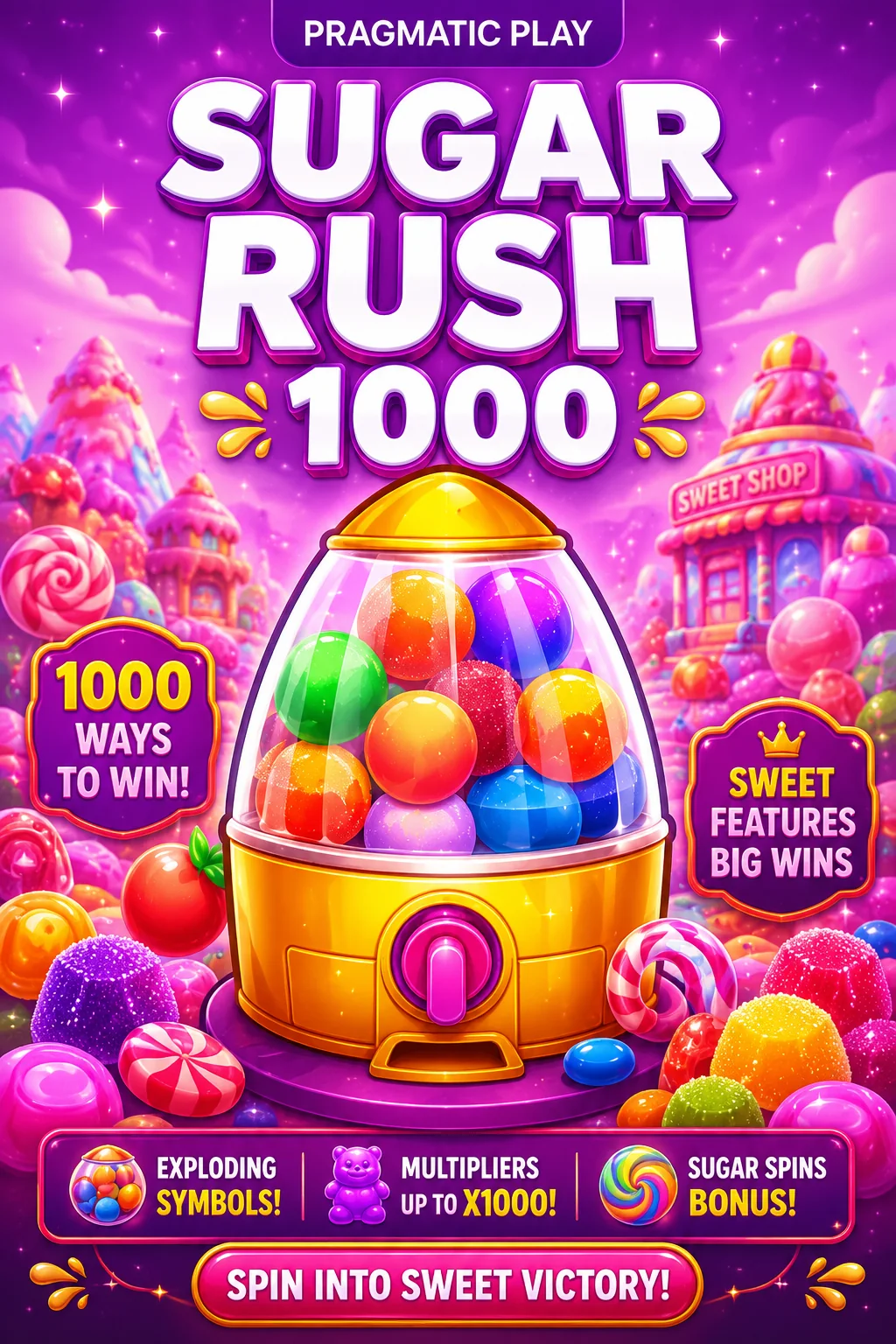
First taste
Bright candy hides a demanding high-volatility cluster game.
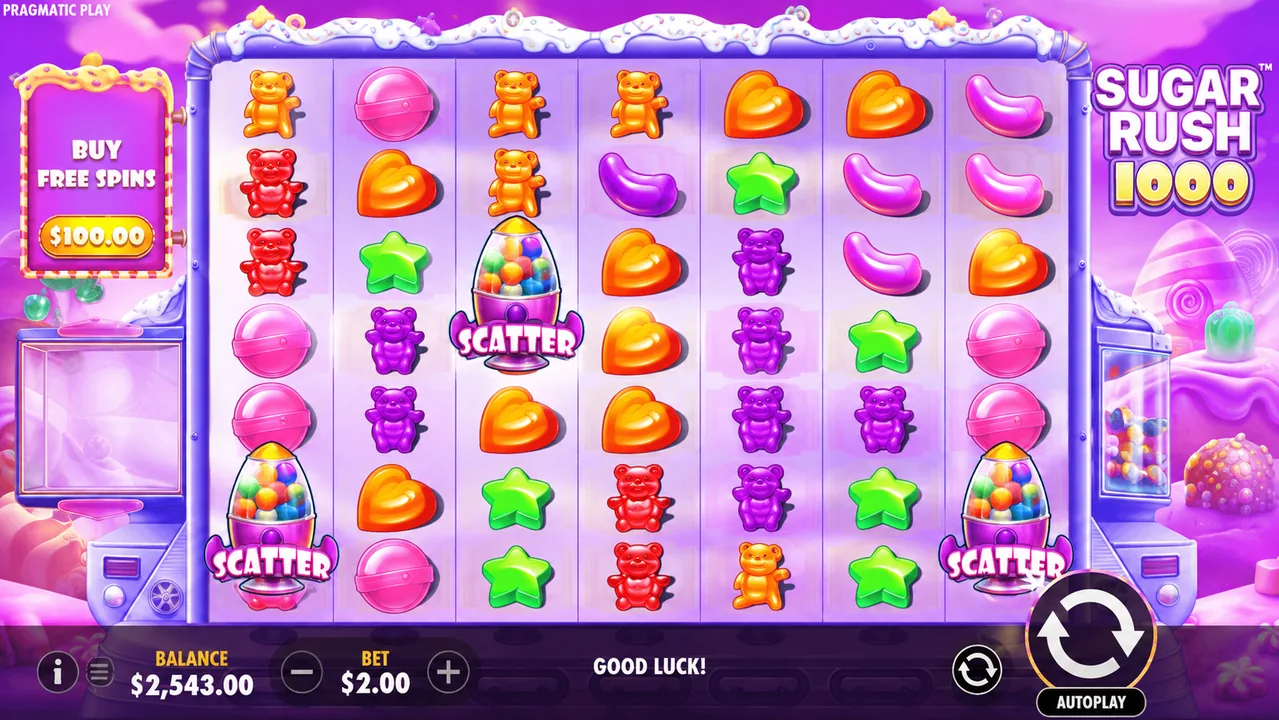
Sugar Rush 1000 looks like a simple candy slot, but its main feature is the 7×7 grid. There are no paylines to follow. A win needs at least five matching symbols connected horizontally or vertically. After they disappear, new symbols fall into the empty cells.
The sequel keeps the cheerful design of Sugar Rush and increases the maximum values. A multiplier position can reach 1,024×, while Pragmatic Play states a maximum win of 25,000 times the stake. These figures are limits, not typical results or promised returns.
The game suits players who enjoy cascades, changing grid positions and bonuses that develop over several drops. It is less suitable for anyone tempted to raise the stake after a near win or because a marked cell has not paid again. Multiplier positions remain active during Free Spins, but every new symbol is still random.
Facts before the first tumble
The headline numbers matter only when their limits are understood.
Pragmatic Play released Sugar Rush 1000 in March 2024 as a stronger sequel to Sugar Rush. It uses a fixed 7×7 grid, cluster pays and tumbling wins. The published multiplier-spot ceiling is 1,024× and the maximum game win is 25,000× the total stake.
The commonly published default RTP is 96.53%, with high volatility. Pragmatic Play titles can be supplied in different certified RTP configurations, and optional feature modes may use their own return figures. I therefore treat 96.53% as a reference and verify the exact value in the help panel of the opened game.
RTP describes a theoretical return over a very large number of rounds. It does not say what one player should receive tonight. High volatility means the route to that long-run figure can include long sequences without a meaningful win, so I choose a stake for the full budget rather than for the size of one possible multiplier.
| Provider | Pragmatic Play | Release | March 2024 |
|---|---|---|---|
| Grid | 7 reels × 7 rows | Win system | Clusters of 5+ matching symbols |
| Default RTP | 96.53%; verify live version | Volatility | High |
| Free Spins | 10–30 from 3–7 Scatters | Maximum win | 25,000× total stake |
| Multiplier spot | 2×, doubles to 1,024× | Core feature | Tumbling wins |
Cluster pays
Five connected sweets start a win; diagonals alone do not join the cluster.
A paying cluster contains at least five identical symbols connected along their edges. A symbol can connect left, right, above or below. Two matching symbols that only touch at a corner do not complete the same cluster, which is why a crowded-looking board may still contain no win.
Cluster size affects the paytable value. I first identify the symbol, then count the connected group and finally read the corresponding multiplier of the total stake in the live paytable. The cash amount shown on screen is the result of that calculation, not the number of sweets by itself.
In demo mode I trace one cluster from a single symbol rather than scanning the entire grid at once. This quickly teaches the difference between a compact connected shape and several separate islands of the same colour. It also makes the following tumble easier to understand.
Tumbling wins
One paid spin can contain several drops, but the whole chain is still one round.
Winning symbols explode and leave empty positions. New symbols fall from above, and the game checks the refreshed board for another cluster. The sequence continues while each new layout produces a win and stops as soon as a drop produces none.
Several consecutive cascades can make the round feel as if it is gaining momentum. In fact, the first click pays for the entire sequence and every refill remains random. A long cascade does not improve the chance of another cascade on the next paid spin.
I wait for the win meter and all animations to settle before pressing again. This is not a strategy for changing the result; it is a practical way to see which cluster paid, which positions were marked and how the game reached the displayed total.
Multiplier spots
Repeated wins on the same cells can lift a marked position from 2× to 1,024×.
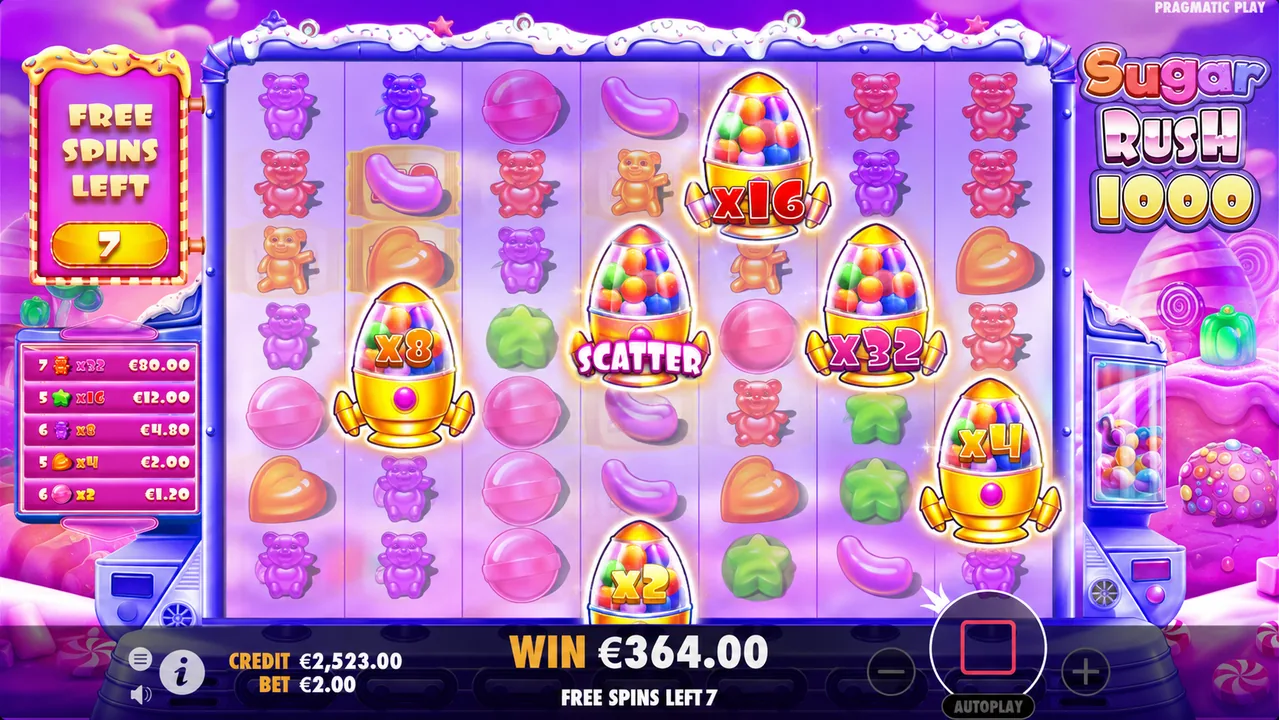
When a winning symbol disappears, its cell is marked. If a later winning symbol explodes on that marked cell, a multiplier begins at 2× and doubles on further qualifying hits: 4×, 8×, 16× and onward to the official ceiling of 1,024×.
The value belongs to the position, not to the candy symbol that created it. A different matching sweet can use the same cell on a later tumble. When a winning cluster covers marked positions, the game applies the relevant spot values to that cluster according to the on-screen calculation.
A large multiplier matters only when a later winning cluster uses that position. An isolated 256× or 1,024× mark is not a cash prize, and the game does not have to use that area again. I treat marked cells as possible multipliers, never as money already won.
Free Spins
Scatter count sets the starting length, while marked spots stay sticky through the bonus.
Three, four, five, six or seven Scatter symbols award 10, 12, 15, 20 or 30 Free Spins respectively. This schedule is stated by Pragmatic Play. Additional Scatters during the feature can add more spins, with the exact retrigger display shown in the live game.
The important bonus rule is persistence. Marked multiplier positions do not reset after each Free Spin, so one part of the grid can develop over several rounds. A spot that reaches 8× can remain available for later clusters and may continue doubling when the required win uses it again.
Persistence increases the feature's range of possible outcomes, not its certainty. A bonus can finish with attractive multipliers that never receive another qualifying cluster. Free Spins are included in the game's high-volatility mathematics and can return less than the triggering stake or a purchase price.
What changed from Sugar Rush
The sequel keeps the same grammar and raises the multiplier and win ceilings.
The original Sugar Rush uses the same 7×7 cluster layout, tumbles and sticky multiplier positions, but its position multiplier tops out at 128× and its maximum win is 5,000×. Sugar Rush 1000 raises those headline limits to 1,024× per spot and 25,000× overall.
The name does not mean that every prize is one thousand times larger. It identifies a more powerful edition, not a fixed multiplier for all wins. The cluster rules and the basic rhythm remain familiar to players of the original 2022 game.
The choice between the two games should depend on preferred pace and volatility, not only on the largest advertised number. The 1000 edition gives rare multiplier growth more importance. Its higher maximum can also make ordinary losing periods feel longer.
Symbols and paytable
The board is simple to read once cluster size and spot multipliers are kept separate.
Gummy bears, hearts, stars, jelly beans and round candies make up the regular symbol set. Their paytable values differ, and larger connected groups pay more than the minimum five-symbol cluster. I use the information panel rather than guessing value from colour or screen size.
The gumball-machine Scatter does not need to join a regular cluster. It is counted across the whole 7×7 grid for Free Spins. Regular sweets still follow edge-to-edge cluster rules, so Scatter logic and cluster logic should not be mixed when reading a result.
A multiplier label is another separate layer. First the game evaluates the cluster and its base paytable value; then applicable marked positions modify the result. Watching those stages in demo is much clearer than trying to infer the payout from the final celebration alone.
Demo and optional modes
A short demo checklist reveals more than chasing a sample profit.
I begin with the smallest virtual stake and watch one complete base-game tumble. I confirm how diagonal symbols are treated, how marked positions appear, when a spot first becomes 2× and how the total changes when several marked cells take part in one cluster.
Where local rules allow it, an operator may show ante, feature-spin or bonus-buy controls. These options change the price or entry conditions; they do not remove randomness or guarantee that the feature returns its cost. I convert any displayed price into cash before touching it.
My final demo check is practical: can I see the balance, total stake, remaining Free Spins, spot values and stop control without guessing? The goal is familiarity with the interface and volatility. A profitable demo sample says nothing about the next real-money sequence.
RTP, volatility and limits
I plan for ordinary losing spins, not for the 25,000× ceiling.
A 96.53% default RTP still leaves a mathematical house edge, and the configured version can differ. I open the game information before staking because the number attached to the title in one casino is not automatically the number used by every operator.
High volatility concentrates more of the return in less frequent results. That can produce long quiet stretches followed by a busy tumble or bonus. I do not respond to a dry sequence by increasing the stake, because previous results do not make a future cluster due.
Before playing I set three values outside the game: stake per spin, maximum total spend and a finishing time. If an optional purchase would cross the remaining limit, it is unavailable to me regardless of how appealing the current grid looks.
Mobile play
The 7×7 grid works on a phone when controls and multiplier labels remain readable.
Sugar Rush 1000 fits modern mobile browsers, but forty-nine cells, spot values and the win meter compete for limited space. I prefer landscape orientation when the portrait layout makes multiplier labels too small, and I keep the total stake visible before every new round.
I avoid rapid taps while a tumble is still resolving. Waiting prevents accidental repeated inputs and makes it easier to follow the marked positions. A stable connection improves presentation, but it cannot alter the random symbols or make a bonus more likely.
The same budget applies across desktop and mobile. A smaller screen should not make spend feel less real. If the interface hides limits, obscures the stake or encourages hurried decisions, I leave it rather than adapting the budget to the design.
Game screens
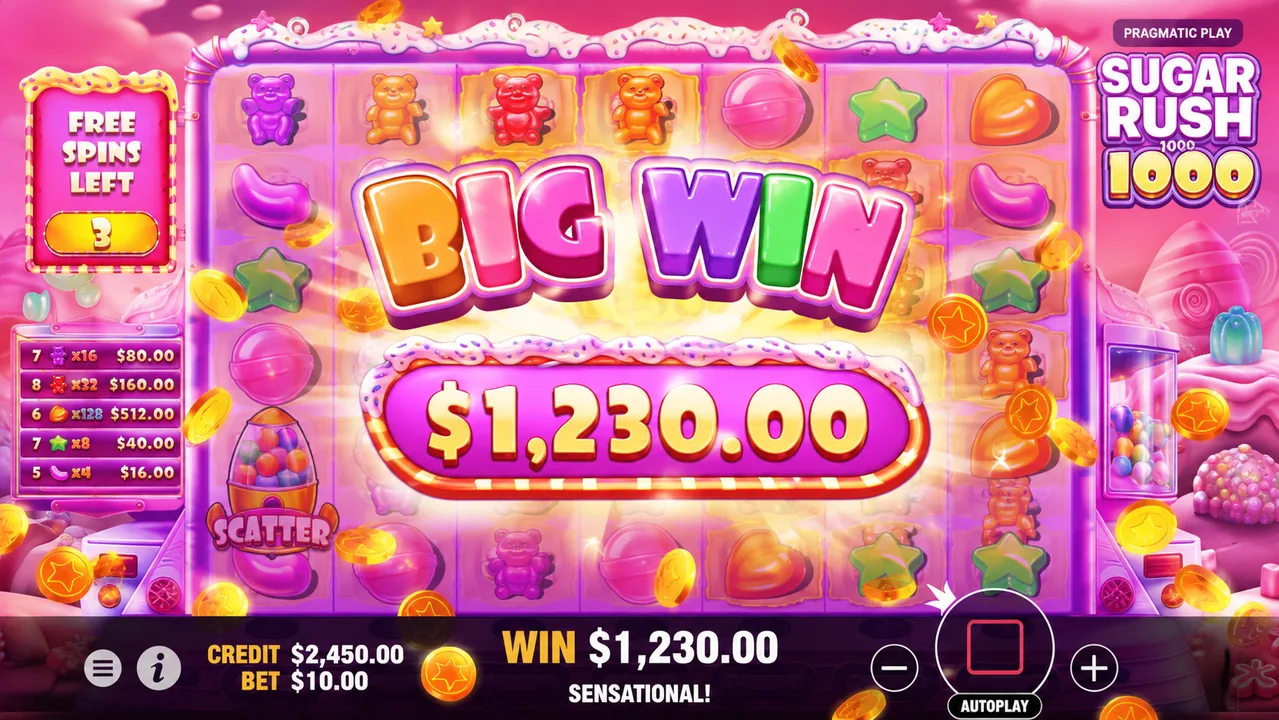
Base play, sticky Free Spins multipliers and a completed big win.
The supplied screenshots show the interface rather than guaranteed outcomes. Currency amounts are examples from those captured rounds; official rules, the active RTP and stake limits come from the information panel of the opened game.
My limit before the sugar rush
I budget for quiet stretches, not for a 25,000× headline.
I set the stake, total spend and finish time before the first spin. Tumbles and sticky multipliers can make a bonus feel as if it is building toward something, but they do not make a future cluster predictable.
If a larger stake, feature purchase or new deposit begins to look like a way to recover a loss, I stop. Demo practice, time-outs and operator limits help with control; systems and loss chasing do not.
See the rules before the sweets
Use the demo to learn the grid, then decide whether its volatility suits you.
Keep the stake visible, verify the live RTP and let the 1,024× spot remain a ceiling rather than a target.
Sugar Rush 1000 FAQ
Clear answers about clusters, tumbles, multipliers, Free Spins and RTP.
What is Sugar Rush 1000?
Sugar Rush 1000 is a high-volatility 7×7 cluster-pays slot released by Pragmatic Play in March 2024. It uses tumbling wins, marked multiplier positions, Free Spins and a maximum win of 25,000× the total stake.
What is the Sugar Rush 1000 RTP?
The commonly published default RTP is 96.53%, but Pragmatic Play games can be configured at other certified values. Check the information panel of the opened game for the exact RTP in use.
How do clusters pay?
At least five matching symbols must connect horizontally or vertically. Winning symbols disappear, replacements tumble from above and another cluster can pay within the same spin.
How do multiplier spots reach 1,024×?
Winning positions become marked. Repeated qualifying wins on the same cell start a 2× multiplier and double it through 4×, 8× and higher values up to 1,024×.
How many Free Spins can Scatters award?
Three, four, five, six or seven Scatters award 10, 12, 15, 20 or 30 Free Spins. More Scatters during the feature can add spins, and multiplier spots remain sticky through the bonus.
Is there a way to predict the next cluster?
No. Cluster shapes, tumbles, Scatters and repeated hits on multiplier cells are random. Demo play and fixed limits can improve understanding and control, but they cannot change the odds.
Core mechanics and headline limits were checked against the official Pragmatic Play game page and its official release article. Operator configurations and feature availability may differ; the opened game's information panel is the final reference.